


The Department for Education’s rollout of Apprenticeship Units has been met with a mix of enthusiasm and quiet apprehension across the Further Education sector.
On paper, the premise is fantastic. Offering bite-sized, high-impact training modules extracted from full apprenticeship standards gives adults and employers the flexibility they’ve been crying out for. It opens up new funding streams, helps bridge immediate skills gaps, and positions FE colleges and Independent Training Providers (ITPs) as agile partners to industry.
But let’s talk about the operational reality.
For Quality Leads, Curriculum Managers, and Apprenticeship Directors, shorter units present a distinct monitoring nightmare. When you condense learning into modular, bite-sized delivery, your learner turnover accelerates. What used to be a steady, year-long monitoring rhythm suddenly becomes a high-speed assembly line of onboarding, progress tracking, evidence gathering, and review.
If your current setup relies on bloated Word documents, sprawling spreadsheets, or rigid VLE tracking that nobody actually enjoys using, the administrative burden of these new units is about to hit your team hard.
The Hidden Admin Trap of Modular Apprenticeship Units
Monitoring shorter apprenticeship units requires a completely different pacing to traditional 12- to 36-month standards. Here is why it’s causing a headache for FE providers:
1. High Throughput, Higher Admin Volume
With shorter units, you aren't tracking a learner once a term; you’re tracking rapid, week-by-week competency gains. If your tutors are spending two hours updating qualitative evidence logs for every three hours of teaching, the delivery model becomes financially and humanly unsustainable.
2. Proving "Distance Travelled" in Record Time
Ofsted hasn't relaxed its expectations just because a unit is shorter. Inspectors still want to see clear baseline judgements, robust verification against criteria, and demonstrable "distance travelled". Demonstrating rapid progress across a 10-week unit without drowning staff in paperwork is a delicate balancing act.
3. Diagnosing Workplace Barriers Faster
In a three-year apprenticeship, you have time to iron out employer engagement hiccups, off-the-job release issues, or workplace mentoring gaps. In a standalone unit, if an employer fails to provide access to a specific task in Week 2, the whole unit is compromised by Week 6. You need an immediate diagnostic system to spot what’s hindering progress before the learner falls behind.
4. Aggregating Quality Across Diverse Employer Sites
How do Quality Managers get a bird’s-eye view of how a specific unit is performing across thirty different employer locations? Standard reporting tools give you completion stats, but they rarely give you human insight into why one cohort is thriving while another is stalling.
Enter iAbacus: Quality Assurance Through Human Insight, Not Spreadsheet Fatigue
At iAbacus, we’ve spent decades studying how educational organisations improve. We know that teachers and vocational assessors don't suffer from a lack of insight—they suffer from tools that turn their professional judgment into bureaucratic admin.
iAbacus was built to take the friction out of evaluation and planning. Built on 50 years of research and designed around a deceptively simple visual metaphor, it replaces pages of static Word-based SARs and QIPs with an intuitive, dynamic process that staff actually enjoy using.
Here is how iAbacus directly solves the monitoring and workload challenges of the new Apprenticeship Units:
[ Evaluate & Evidence ] ➔ [ Diagnose Helps/Hinders ] ➔ [ Action Plan ] ➔ [ Track Visually ]
1. Kinaesthetic, Instant Progress Tracking
Instead of filling out endless qualitative boxes, assessors start by sliding a bead across an abacus screen to make an instant, visual judgement of where a learner or cohort stands against the unit criteria.
It takes seconds, but it captures immediate professional insight ("nous"). From there, assessors link concise workplace evidence, line manager notes, or task completion records directly to the bead.
2. Spotting Employer & Delivery Barriers with "Helps & Hinders"
At the heart of iAbacus is Kurt Lewin’s force-field analysis—a diagnostic step that asks two fundamental questions:
- What is HELPING success in this unit? (e.g., highly supportive workplace mentor, strong prior digital literacy).
- What is HINDERING success? (e.g., lack of off-the-job release time, delayed equipment access).
By forcing a quick diagnosis of these forces before writing an action plan, tutors and leads can target the exact barrier holding the unit back. If three apprentices at the same employer are struggling, a glance at the "Hindering" column tells you instantly whether it’s a teaching issue or an employer release issue.
3. "Overlay" and "Stack" Features: Macro Insights for FE Leaders
This is where iAbacus becomes a superpower for Vice Principals, Quality Directors, and Heads of Apprenticeships.
Using our unique Overlay feature, you can take thirty individual tutor or cohort evaluations for a specific Apprenticeship Unit and superimpose them onto a single master screen.
- Want to see how the new Leadership & Management unit is performing across five regional campuses? Overlay them.
- Want to compare how different employer cohorts are progressing against off-the-job criteria? Stack them vertically.
Instead of reading thirty separate reports, you get an instant, panoramic dashboard. You can see clusters of beads showing high performance, spot outlying cohorts that need urgent intervention, and click directly into any bead to read the exact human narrative and evidence behind the rating.
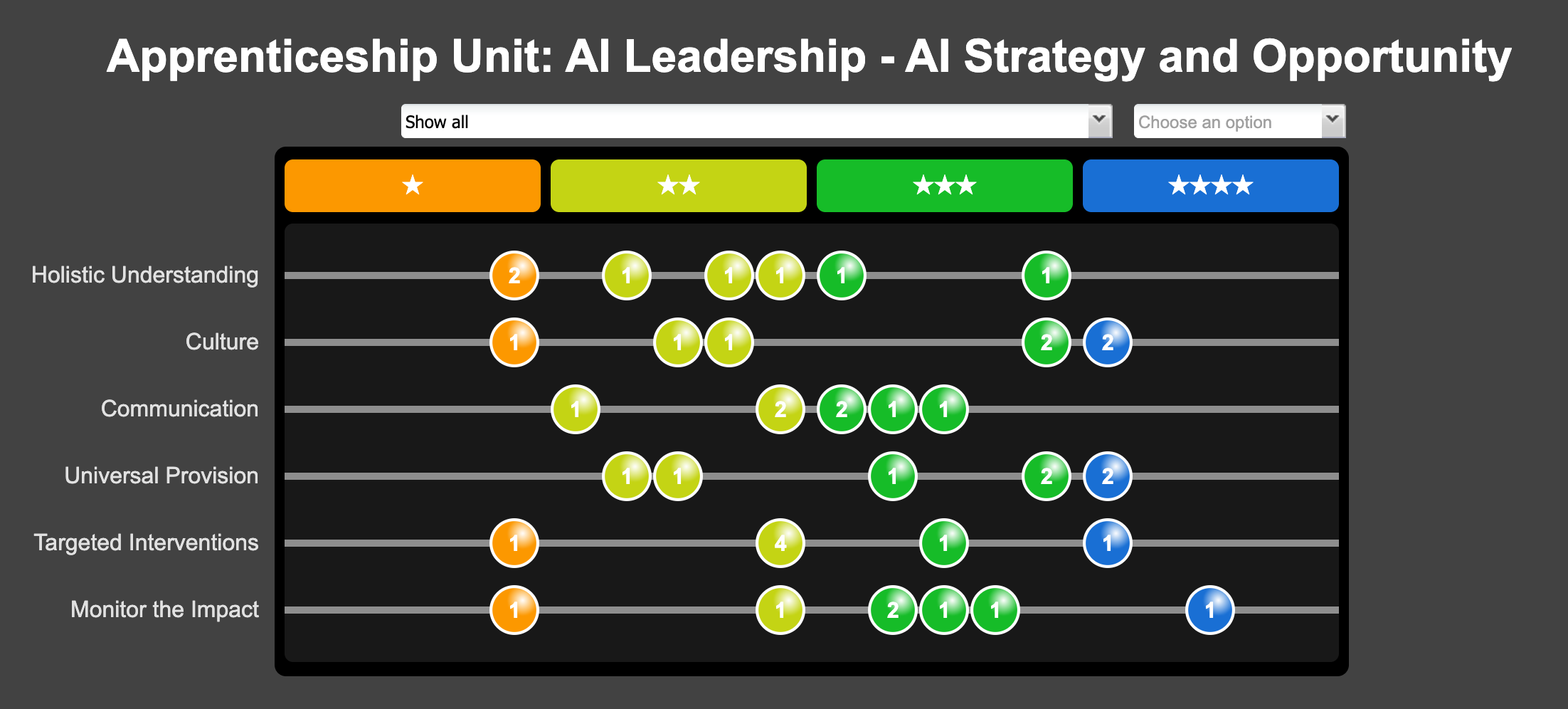
Visualising multiple cohort judgements on a single overlay screen.
4. One-Click, Inspection-Ready Reporting
When Ofsted or funding auditors step through the door, nobody has to spend a frantic weekend copy-pasting data into a master spreadsheet.
iAbacus generates polished, visually compelling PDF reports in a single click. You can export a high-level summary for the Board or an in-depth, evidence-linked report for an inspector, proving that your provider has complete oversight of every apprenticeship unit being delivered.
Built for FE, Backed by Unlimited Support
We know that rolling out new systems in FE can be met with skepticism from time-poor staff. That’s why an iAbacus subscription isn't just a piece of software - it’s a full operational partnership.
Every subscription includes unlimited, bespoke support at no extra charge:
- Custom Template Design: We will build your specific Apprenticeship Unit frameworks directly into iAbacus templates so your team can hit the ground running.
- Staff Training & INSETs: We deliver flexible online or in-person sessions to train assessors, quality managers, and curriculum leads.
- 1-to-1 Coaching & Project Management: We help your Quality Leads design a roll-out strategy that fits your existing observation and QA cycles.
Stop Wading Through Documents. Start Driving Impact.
The new Apprenticeship Units are a huge growth opportunity for FE providers, provided you don't let the administrative overhead swallow your margins and exhaust your staff.
iAbacus gives you a single, clear, and elegant framework to judge performance, diagnose barriers, collaborate with staff, and prove impact without the paperwork hangover.
Ready to see how iAbacus works for your college or training organization?
- Book a 15-Minute Demo: See how our Overlay and Apprenticeship templates work live at meet.iabacus.com.
- Start a Free Trial: Explore the platform with your team today at www.iabacus.com/trial-demo.
- Explore FE Uses: See our full range of Further Education solutions at www.iabacus.com/uses/by-school-type/further-education-sixth-form-colleges.


