


Every September, nursery managers across the country sit down and write an improvement plan. It is thoughtful. It is well intentioned. It covers the right areas.
By February, most of it has not happened.
Not because the manager stopped caring. Not because the priorities were wrong. Because somewhere between writing the plan and running the setting, the plan quietly stopped being part of the work.
Why improvement plans stall
If you have led a setting, or a group of them, you will recognise the pattern.
The plan is written for someone else. It is produced because it is expected — by head office, by an inspector, by the local authority. It gets filed where they can find it. It is rarely opened again.
The actions are too vague to act on. Improve outdoor provision. Develop staff confidence in SEND. Strengthen parent partnerships. These are aims, not actions. Nobody knows what to do on Monday morning.
Nobody owns them. An action without a named person belongs to everyone, which means it belongs to no one.
The plan is disconnected from the evaluation. The self-evaluation says one thing. The improvement plan, written separately and often weeks later, says another. The reasons behind each action get lost in between.
Nothing tracks progress. There is no moment where anyone asks, how far along is this? So the plan drifts until the next deadline brings it back to the surface.
Nobody is doing this badly on purpose. They are just busy running a setting. But the result is the same: effort that never turns into improvement.
A good plan starts with an honest diagnosis
The most common reason a plan fails is that it was never really connected to the problem.
In iAbacus, the plan is not written separately. It grows directly out of the evaluation. The manager makes an honest judgement about one area, tests it against the Ofsted toolkit criteria, and backs it up with evidence. Then comes the step that makes the plan work: the analysis.
The manager identifies what is helping the setting perform at its current level, and what is hindering it from going further. Green on the left. Red on the right. The bead sits between them, held in place by the balance.
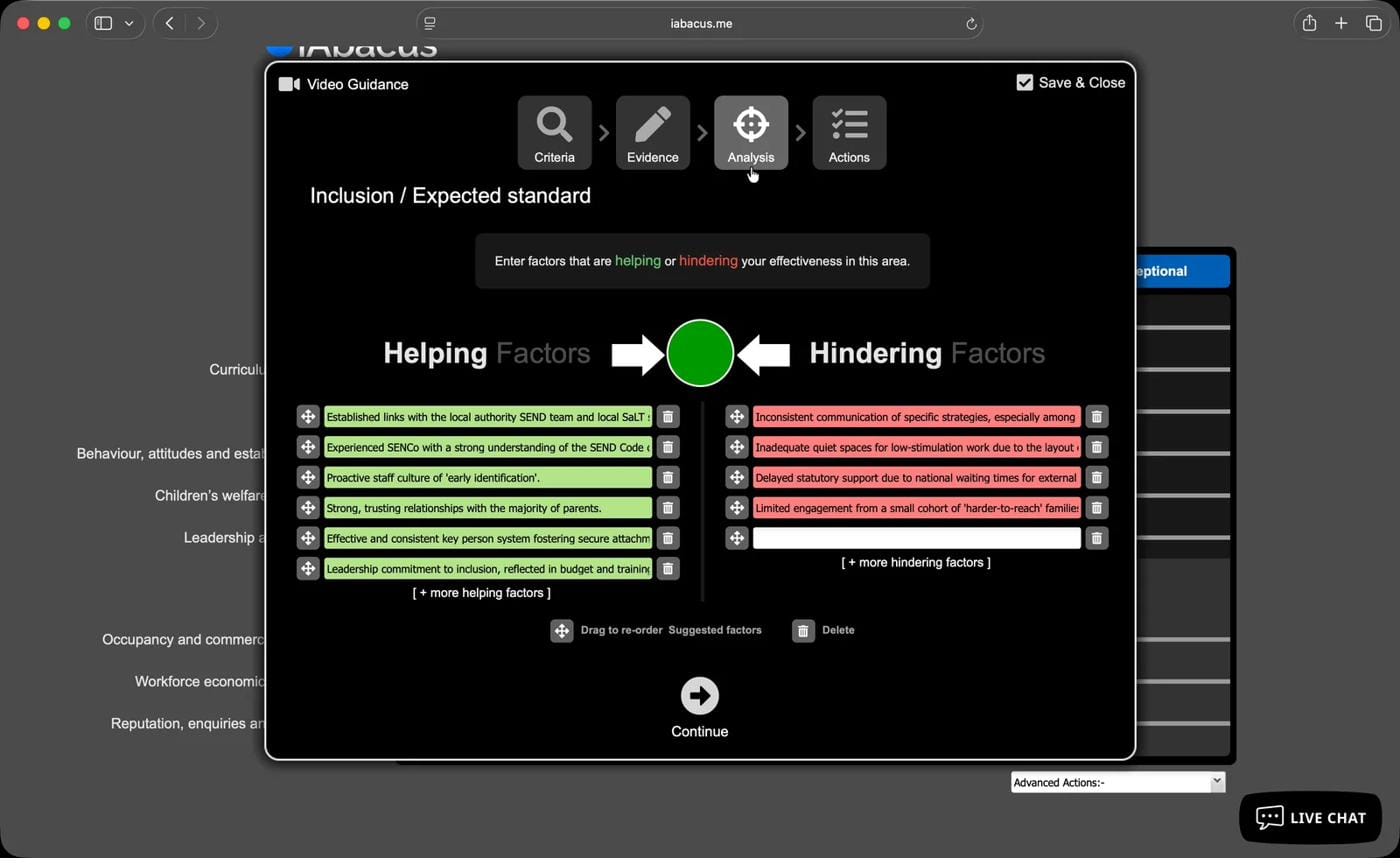
Those hindering factors are the diagnosis. Room leaders are new and still building confidence. Observations are inconsistent between rooms. Parents are not always clear what their child is learning. Specific, honest, and in the manager's own words.
That is what a plan should be built on. Not a generic aim, but the real reasons a setting is not yet where it wants to be.
Actions that can actually happen
Every hindering factor then becomes a specific action. And every action answers four questions.
- What will be done? A concrete step, not an aspiration.
- Who will do it? A named person, not "the team".
- What will success look like? So everyone knows when it is finished.
- When will it be delivered? A date that means something.
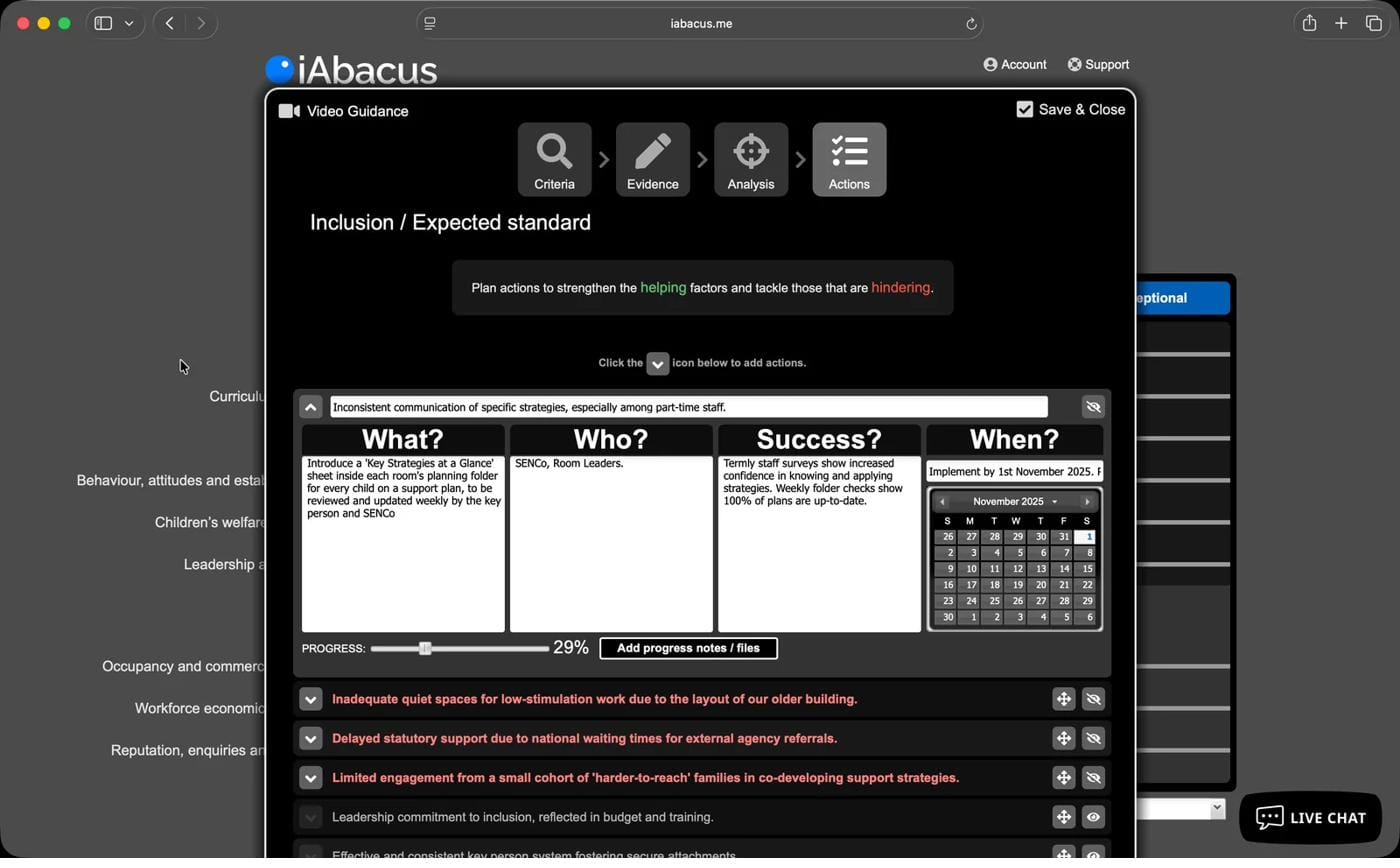
Compare develop staff confidence in SEND with this: SENCo to run three in-room coaching sessions with each room leader by half term; success is every room leader writing their own targeted plan for one child without support.
The first is a hope. The second is something that will happen on a particular Tuesday in a particular room. That is the difference between a plan that stalls and a plan that moves.
A living plan, not a filed document
The final piece is what happens after the plan is written. In most settings, the answer is nothing — until the next deadline.
In iAbacus, the self-evaluation and the improvement plan live in the same place. Progress on each action is tracked as it happens. As hindering factors are addressed, the manager revisits the judgement, and the bead moves. The plan updates as the setting progresses.
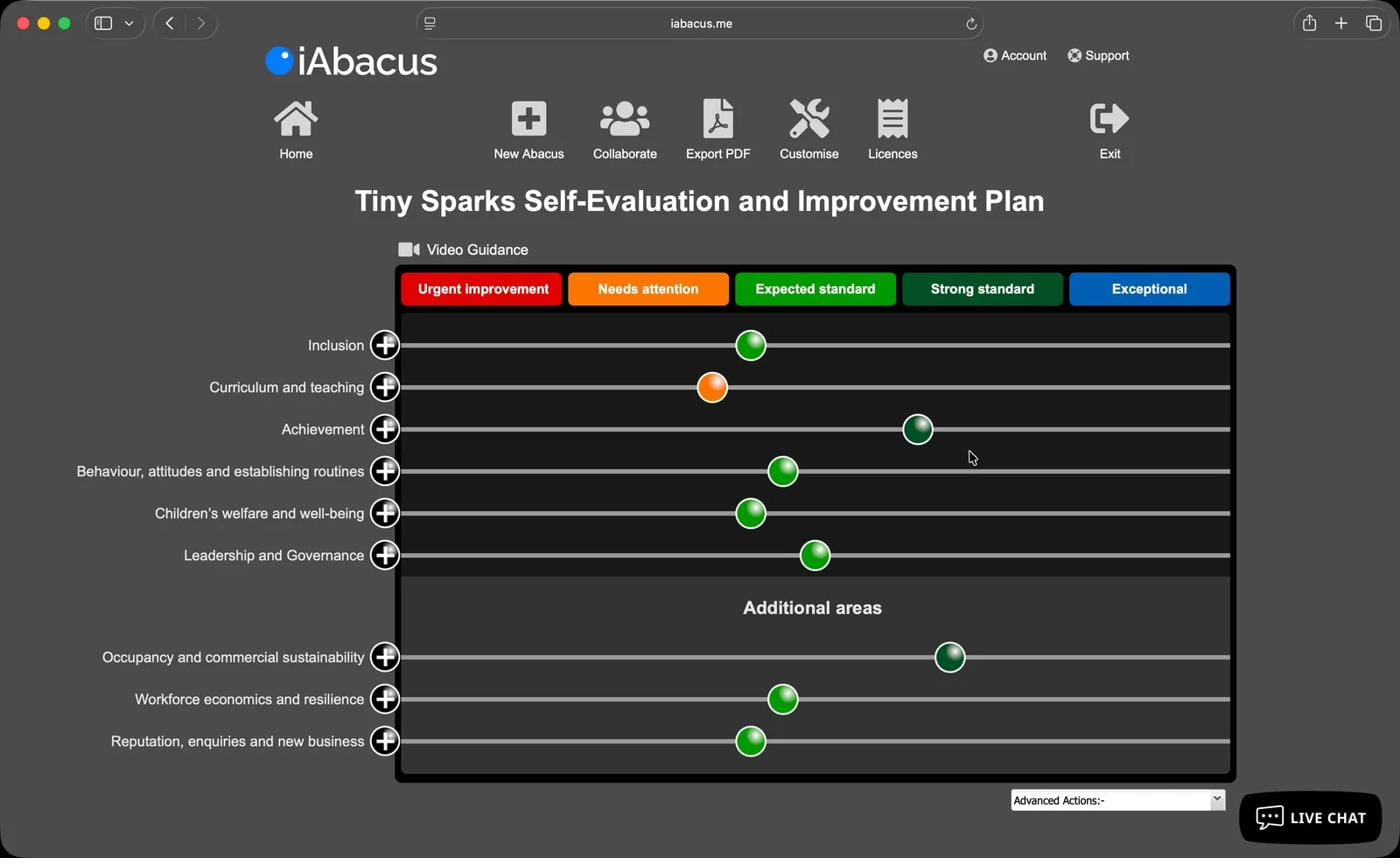
That changes how the plan feels to the people using it. It is not a document for someone else. It is a working tool the leadership team opens because it helps them run the setting — for themselves, not for head office.
And because it is always current, there is no scramble when someone asks where things are. The answer is already there.
What the group sees
For a group leader, stalled plans are one of the hardest things to spot. Every setting says it has a plan. Very few can show you how far along it is.
When every setting works this way, the Nursery Group Dashboard builds itself from their evaluations. No chasing. No compiling. No reports written upwards. You can see where every setting stands across the Ofsted areas and your group's own — and click into any of them to see the analysis and the actions behind the judgement.
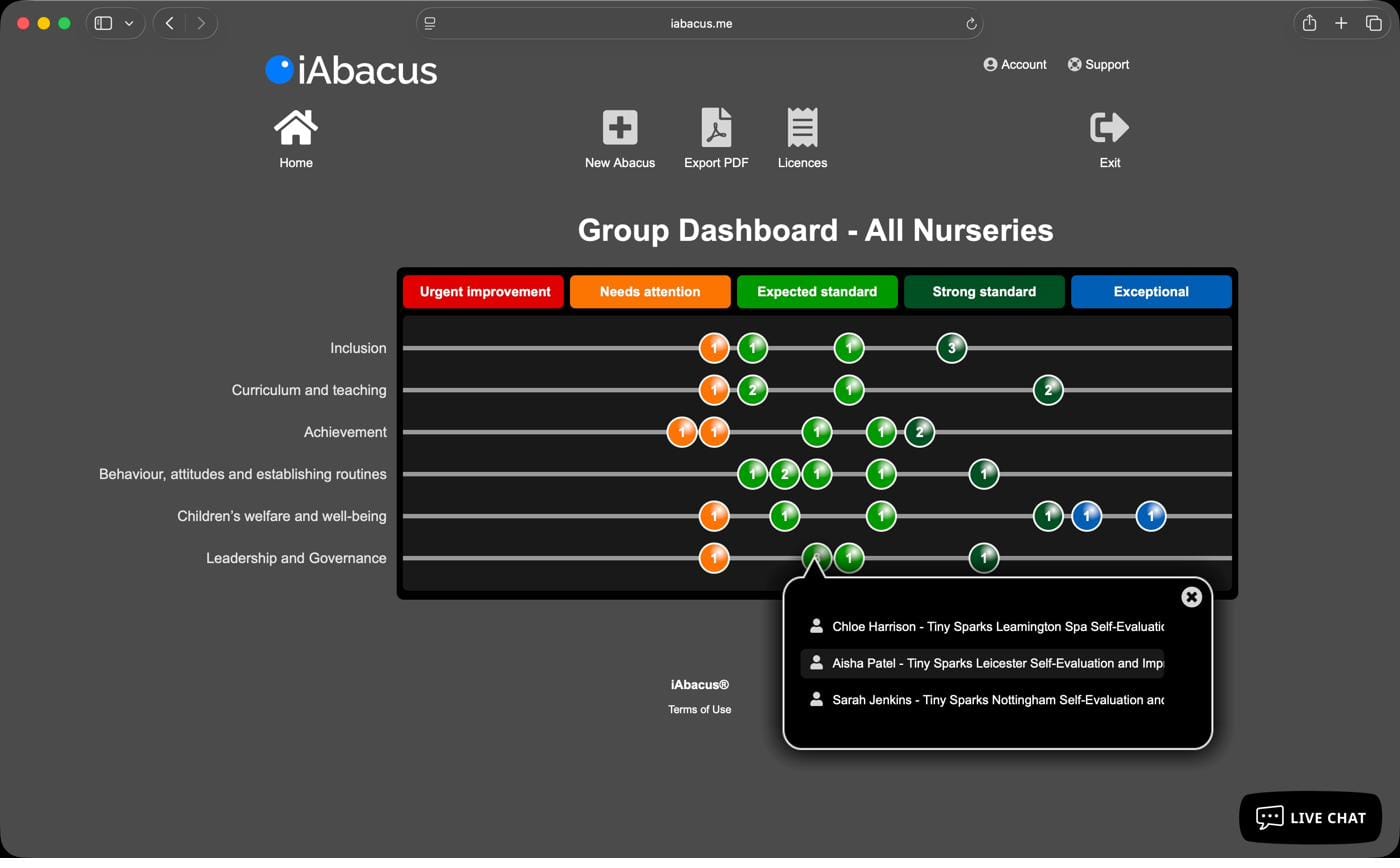
That makes different conversations possible. Not "how is your improvement plan going?" but "I can see the observation actions are nearly done — what difference are you noticing?" Not chasing progress, but supporting it.
And where a setting's actions have stalled, you see it early — while there is still time to help.
Progress you can see
An improvement plan is only worth the improvement it produces. Everything else is paperwork.
The plans that work share the same qualities. They start with an honest diagnosis. They turn every problem into a specific, owned, dated action. They live alongside the evaluation, not in a separate folder. And they are tracked, so progress is visible to the manager and the group alike.
Honest evaluation. Specific actions. Visible progress.
That is how a September plan is still moving in February.
Find out more
See how the iAbacus Nursery Group Dashboard gives every setting a living self-evaluation and improvement plan — and gives your group a live view of progress across every setting — at ngd.iabacus.com.
Any nursery group can trial the complete solution in one setting at no cost. No obligation, no contract, and no catch.


