


Hindsight is free. Everyone has it. The morning after a disappointing inspection report, every group leader in the country could tell you exactly what went wrong.
The staffing gaps in the baby room. The key person system that had quietly frayed. The manager who was stretched across too much for too long. It all seems obvious now.
That is the thing about hindsight. It always arrives. It just arrives too late to be useful.
The price of finding out afterwards
Hindsight feels free because you do not pay for it directly. But look at what it usually comes attached to.
A report card that shows Needs Attention in an area you believed was fine. A published outcome that parents read before they read anything else. A setting manager who feels blindsided, and a team whose confidence takes a knock. Weeks of recovery planning that could have been months of improvement.
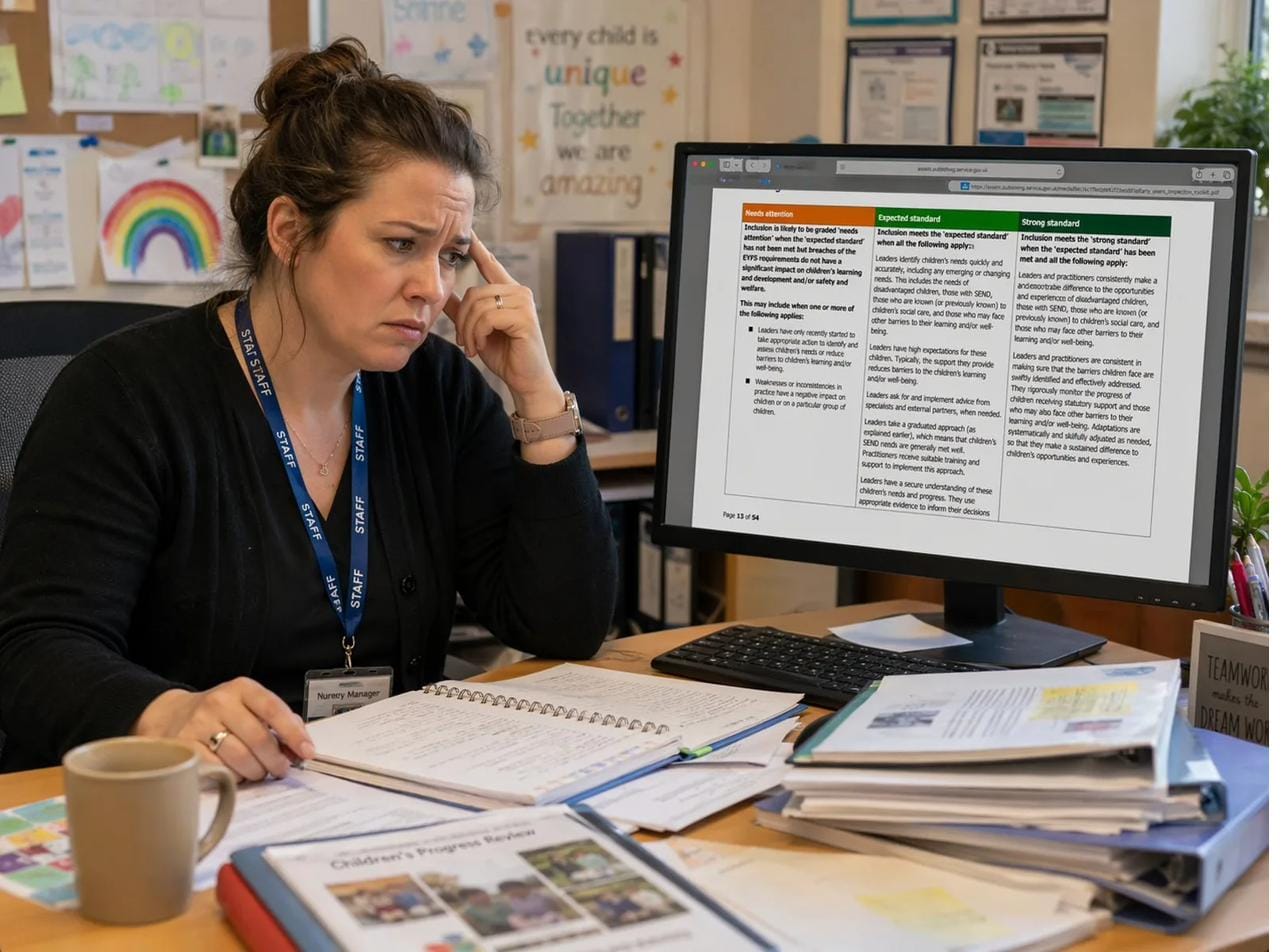
And that is only the Ofsted picture. The commercial side has its own version of the same story. Occupancy that slid for two terms before anyone noticed the pattern. A run of resignations that, looking back, started with one unhappy room leader. Agency spend that crept up a little every month. Parent reviews that turned lukewarm long before they turned negative.
None of these arrive out of nowhere. They build. Slowly, then suddenly.
By the time you see them in hindsight, you are no longer preventing a problem. You are paying for one.
Why groups end up relying on hindsight
Nobody chooses hindsight. It is simply what you are left with when the information arrives late, in pieces, or not at all.
In most settings, self-evaluation gets written, filed, and forgotten. It describes the setting as it was when someone last had time to update it. Improvement plans live in different formats, with varying degrees of rigour. Nobody is doing this badly on purpose — they are just busy running a setting.
At group level, the picture is worse. Different settings, different approaches, different language. The Ofsted picture lives in one set of documents. The commercial picture lives in spreadsheets, email threads, and the head of an area manager who has been meaning to write it up. Two pictures. Both partial. Neither connected.
With a picture like that, foresight is not really an option. You cannot see what is coming if you cannot clearly see what is already here.
What foresight actually requires
Foresight is not a gift some group leaders have and others lack. It is the result of three very practical things.
An honest view of where every setting stands. Not a view shaped for head office. Not numbers performed for an audience. A manager's genuine professional judgement, tested against clear criteria and backed by evidence.
A shared framework across the group. When every setting evaluates against the same areas, on the same scale, in the same language, a change in one setting stands out. You can compare what is finally comparable.
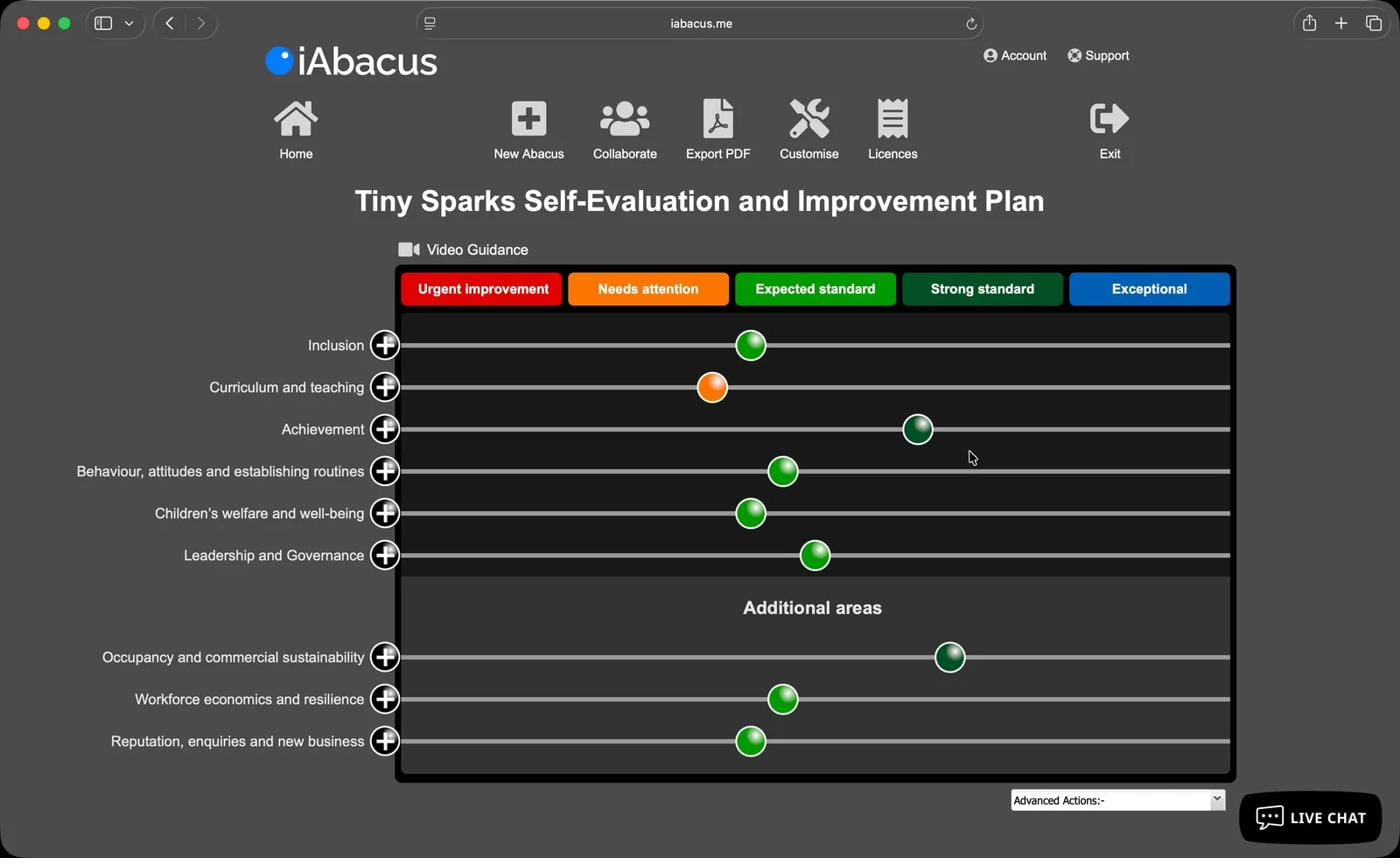
An understanding of why, not just what. A number tells you a setting is sitting at Expected Standard. It does not tell you whether it is about to rise or about to slip. For that, you need to know what is helping and what is hindering.
That last point is where foresight really lives.
Hindering factors are early warnings
In iAbacus, every evaluation includes a force-field analysis. The manager identifies what is helping their setting perform at its current level, and what is hindering it from going further. Green on the left. Red on the right.
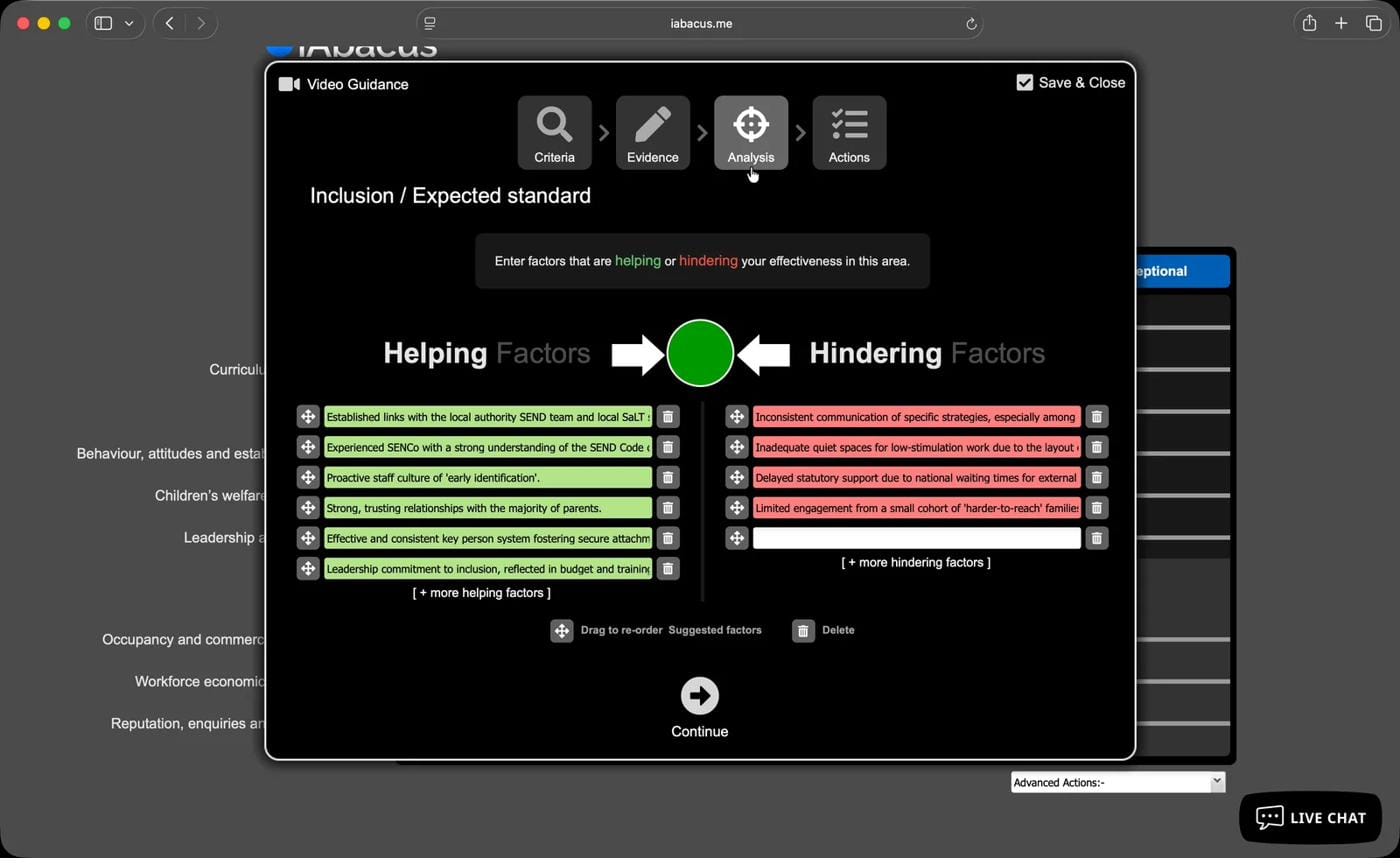
This is the step no data dashboard can replicate. Because the hindering factors a manager writes down today are very often the problems a group leader would otherwise discover in hindsight.
A newly qualified room leader who needs more support than we can give right now. Two key staff on long-term absence. Parent communication has become inconsistent since the app change. Waiting list is shorter than this time last year.
None of these is a crisis. Every one of them could become one.
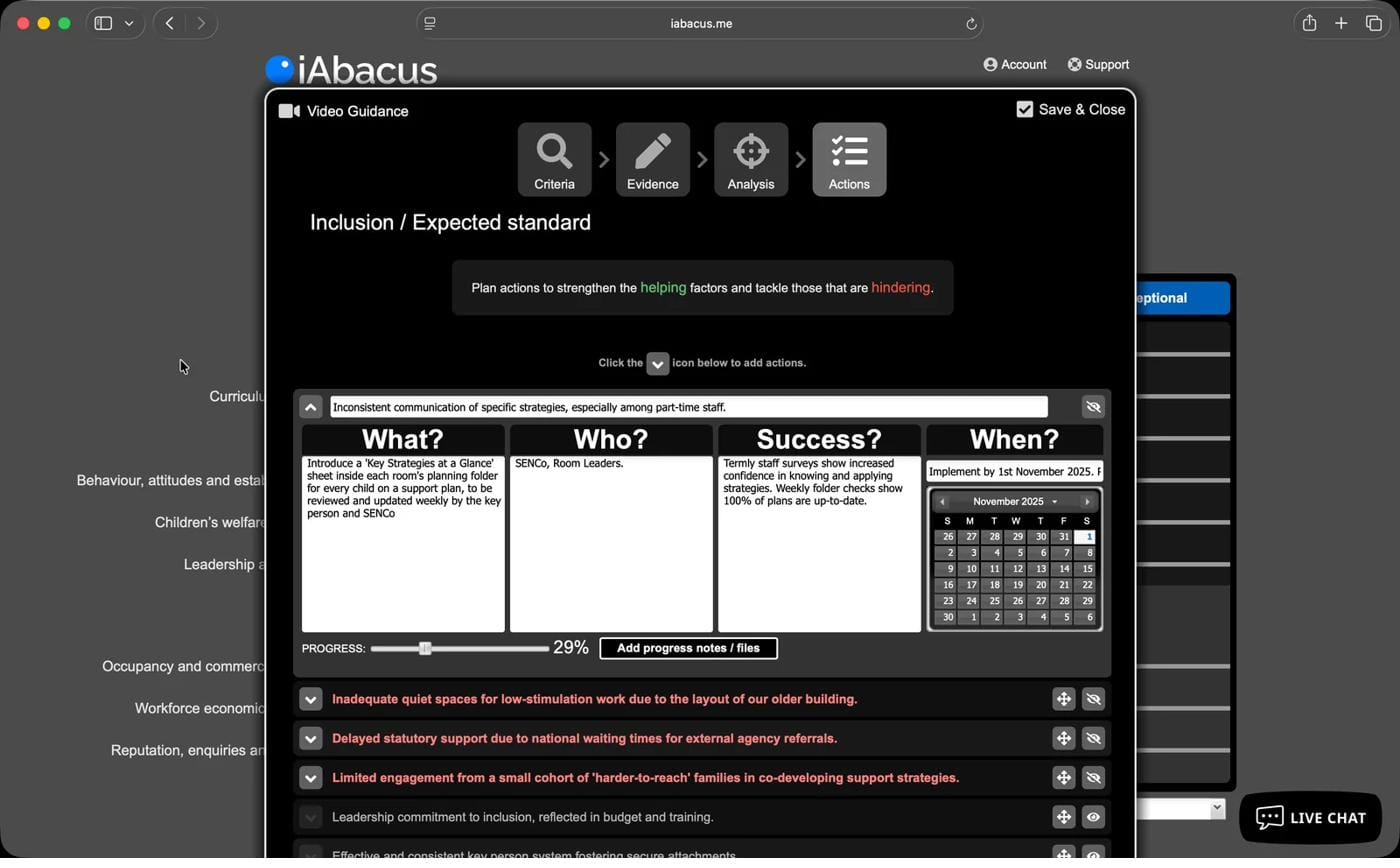
When they are written down, visible, and turned into specific actions — who, what, by when, and what success looks like — they stop being future problems. They become current priorities. That is foresight in its most practical form.
Seeing it coming, across the whole group
Now scale that up.
Every setting in your group completing the same honest evaluation, against the new Ofsted Early Years Inspection Toolkit and against the areas your group runs on — occupancy, workforce, reputation, whatever matters. As each one works through the process, the Nursery Group Dashboard builds itself. No chasing. No compiling. No reports written upwards.
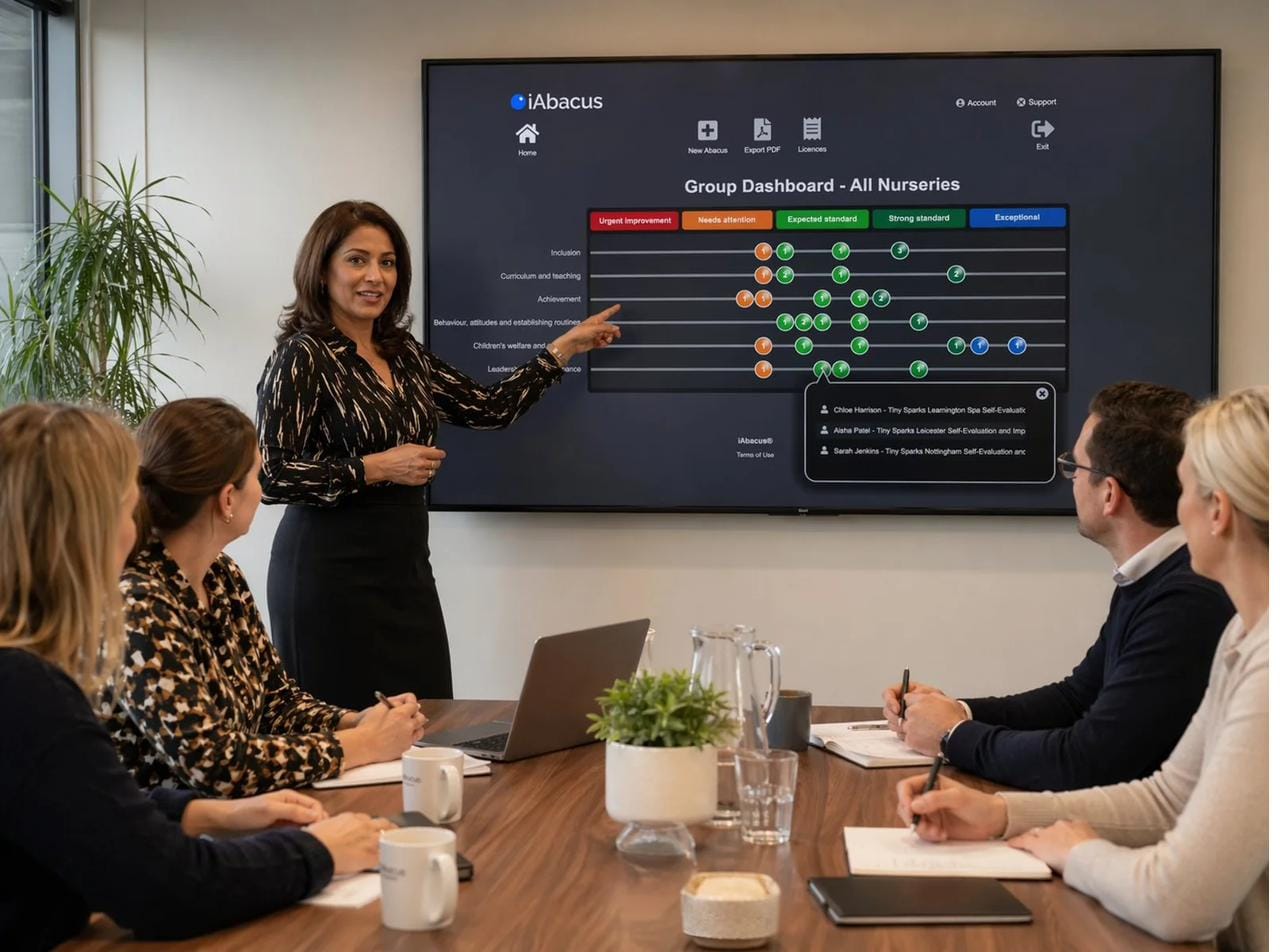
The group leader sees every setting in one place. Where standards are consistently strong. Where a setting has moved from Strong to Expected. Where two settings in the same region are both flagging recruitment as a hindering factor. Click into any of them and the full story is there — the evidence, the analysis, and the action plan.
Blind spots become visible long before they become urgent. Support goes where it is needed, when it is needed, rather than after the damage is done.
That is the difference. Hindsight tells you what happened. Foresight gives you the chance to change it.
The cost comparison
Foresight is not free. It asks something of every setting — an honest, regular evaluation, done properly. It asks the group to work in one framework rather than many.
But set that against the alternative. A downgraded report card. A term of lost occupancy. A manager who leaves because they felt unsupported. The recovery work that follows every one of these costs far more — in time, in money, and in morale — than the evaluation that might have prevented it.
Hindsight looks cheaper. It never is.
One of them you pay for up front, in a structured process your managers can actually use. The other you pay for later, with interest.
The choice is yours. But only one of them is really a choice.
Find out more
See how the iAbacus Nursery Group Dashboard gives your group a live, honest picture of every setting — across Ofsted quality and the commercial measures that matter — at ngd.iabacus.com.
Any nursery group can trial the complete solution in one setting at no cost. No obligation, no contract, and no catch.


