


What the first year of Ofsted's new report cards says about inclusion — and why a weak inclusion grade is almost never an inclusion problem.
Based on 1,425 inspection report cards · September 2026
If you'd asked me to guess which of Ofsted's six judgement areas nurseries struggle with most, I'd have said inclusion without hesitating. Rising numbers of children with additional needs. Budgets that haven't moved. Speech and language waiting lists measured in years rather than months.
I was wrong.
We read every Ofsted report card published for English full-day-care nurseries since the new framework began — 1,425 inspections across 1,647 settings, from November 2025 to last month — and pulled out the grade and the inspector's written narrative for all six areas.
Inclusion came out top. Not bottom. It has the most Strong and Exceptional grades of any area, and the fewest below standard. Leadership and governance, not inclusion, is where nurseries are struggling hardest.
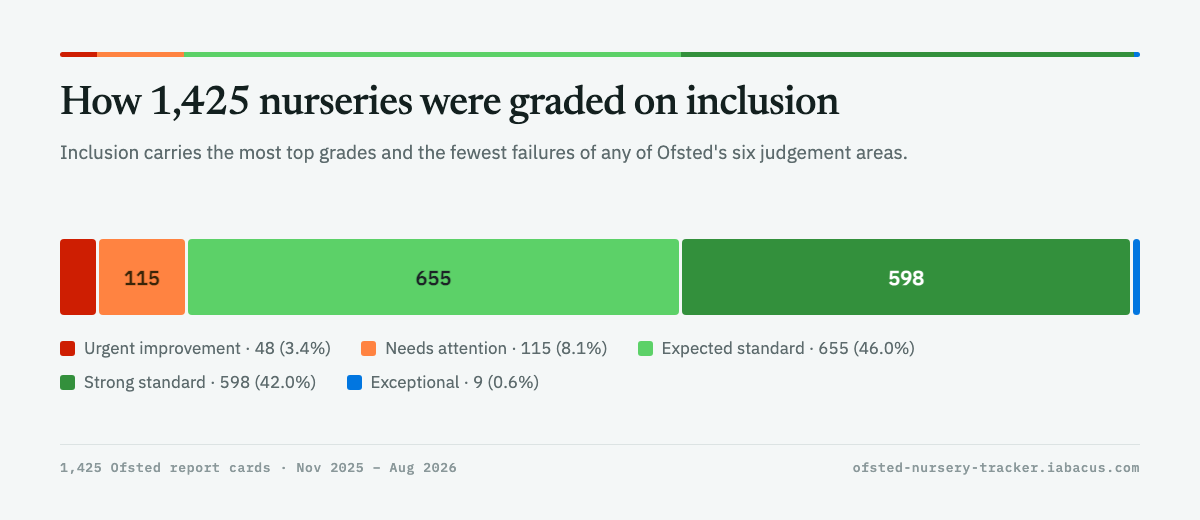
That was the first surprise. The second one is why I'm writing this.
Inclusion never fails on its own
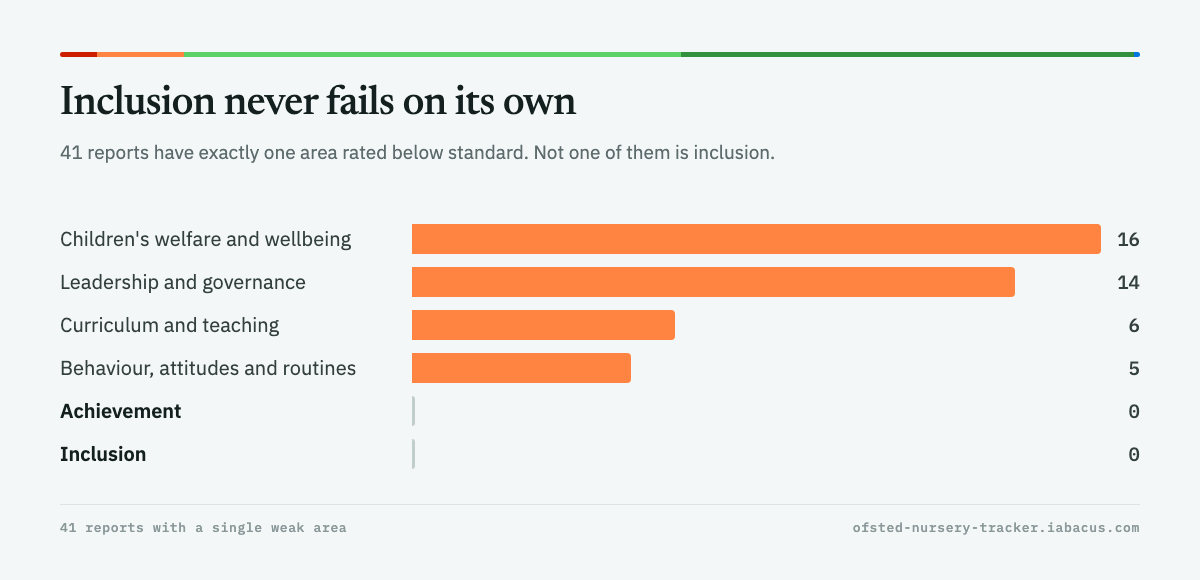
Forty-one of those reports have exactly one weak spot — a single area below standard in a report that is otherwise sound.
Not one of them is inclusion.
Welfare fails on its own. Leadership fails on its own. Curriculum, behaviour — every other area turns up somewhere as an isolated problem. Inclusion never does.
Whenever inclusion is weak, something else is weak too — usually several things. Across the 163 reports where inclusion fell below standard, leadership had already gone in nineteen out of every twenty.
And seven in ten of those settings had failed every single area Ofsted rates.
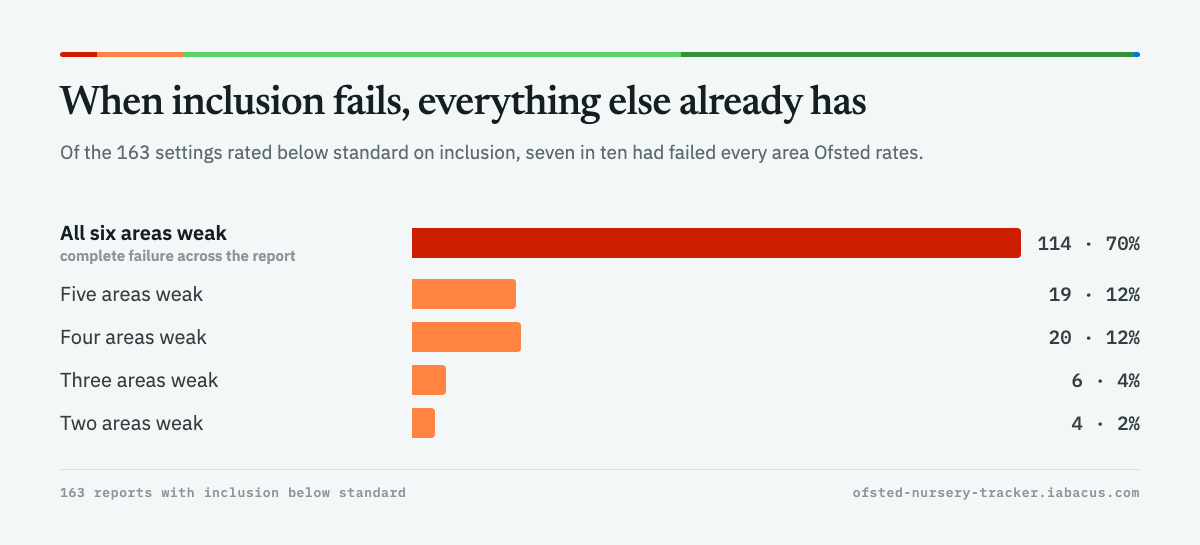
That changes what a weak inclusion grade actually tells you. Most of the time it isn't saying a nursery has an inclusion problem. It's saying the nursery is in trouble everywhere, and inclusion is simply one of the rooms where an inspector could see it.
So when inclusion slips at one of your settings, the instinct — book some SEND training, get the SENCo on a course — is almost certainly treating a symptom. The data says look at leadership first.
On the way up, it moves first
Here's the part I find genuinely hopeful, because the relationship only runs one way.
Inclusion never fails alone. But it succeeds alone all the time.
Of the 607 settings rated Strong or Exceptional on inclusion, 117 had no other area rated 'Strong'. Ordinary on every other measure — and then something genuinely good for the children who need the most.
That's a real route. If you're sitting at 'Expected' across the board and wondering where to push first, inclusion is reachable before the rest of the report catches up.
What separates good from adequate
This is the part I'd want most if I ran a nursery.
We compared what inspectors wrote about settings rated 'Strong' against what they wrote about settings rated 'Expected' — the same analysis, across several thousand sentences of narrative.
The surprise was what didn't separate them.
Settings at 'Expected' standard already bring in speech therapists and educational psychologists. They already spend the additional funding. They already work with parents. On every one of those, they are indistinguishable from settings rated 'Strong'.
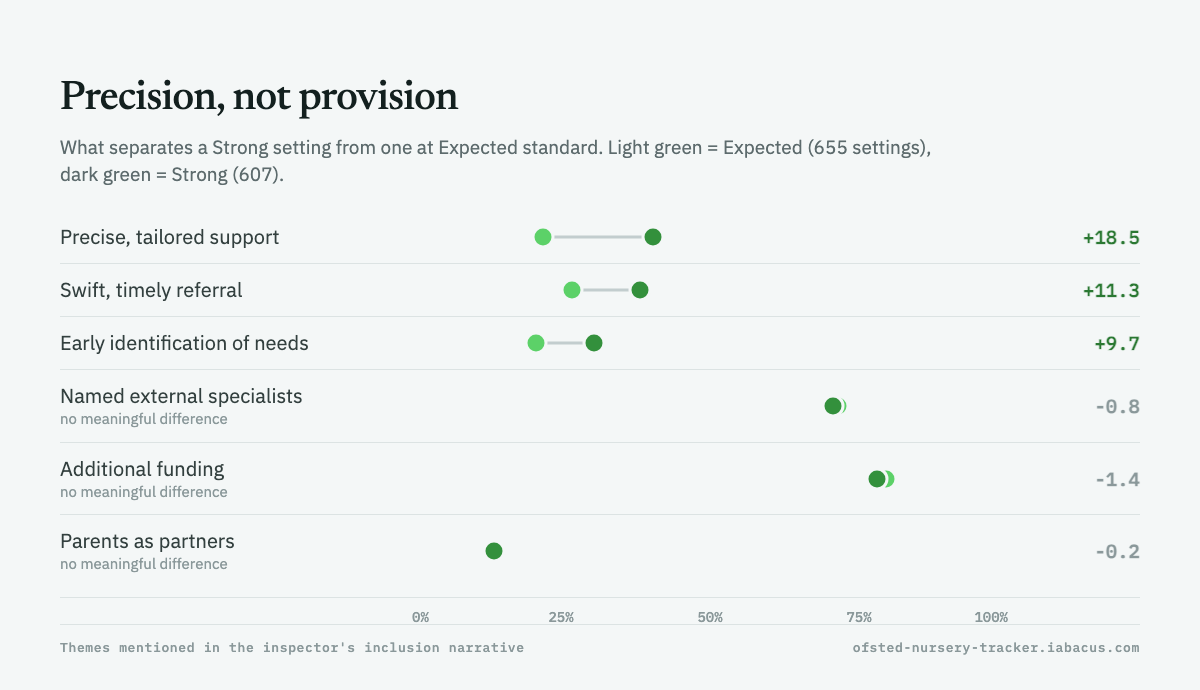
What separates them is how. Support that's precise and tailored to a named child rather than general. Referrals made swiftly rather than eventually. Needs spotted early, rather than once a child is visibly behind.
The gap between 'adequate' and 'good' isn't more provision. It's precision and speed with the provision you already have.
That's cheaper to fix than most people fear. It's also much harder to fake.
One more thing caught me out. Settings rated below standard mention SEND more often than settings rated 'Strong' — not because they do more of it, but because when inclusion is failing, SEND is what the inspector ends up writing about at length. A report thick with SEND language is a warning sign, not a credential.
The averages hide a lot
Among local authorities with twenty or more inspected settings, the share rated 'Strong' on inclusion runs from 62% at the top to 24% at the bottom.
Among the large multi-site operators, one has a single setting below standard across 43. Another has eight below standard across 32.
Same framework. Same year. Same inspectorate.
The full analysis
The whole thing is published here, free and with no sign-up:
ofsted-nursery-tracker.iabacus.com/inclusion
It has the full grade distribution, benchmarks by local authority and by operator, the nine settings rated 'Exceptional', and a practice library of what strong settings actually do — quoted straight from the inspection reports.
If you'd like this cut for your own settings- that part we do by hand. Your group or local authority benchmarked against the operators you actually compete with and your own inclusion narratives read against what the strongest settings are doing.
Email isla@opeus.org with your group name or local authority and we'll send it back. No charge, no pitch attached.
Based on 1,425 Ofsted inspection report cards for providers registered as "Childcare on Non-Domestic Premises, Full day care", inspected between November 2025 and August 2026. Grades and narratives extracted from the published report cards on reports.ofsted.gov.uk.


