


Leading a nursery group is not one big decision. It is hundreds of smaller ones, made every week, often with less information than you would like.
Where should the area manager spend Thursday? Which setting needs the training budget more? Is that manager ready for a second site? What do we tell the board?
Every one of those decisions is only as good as the insight behind it. And for most group leaders, that insight is thinner than it should be.
The decisions group leaders make every week
Think about the last month. How many of these came across your desk?
- Which settings need a visit from the quality team, and which can be left to get on with it.
- Where to spend a limited training budget — and on what.
- Whether a struggling setting needs more support, a different approach, or a different manager.
- Which manager's practice is worth sharing across the group.
- What to put in front of the board, the owners, or an investor.
- Whether the group is ready to open, acquire, or absorb another setting.

These are not small decisions. They shape children's experience, staff wellbeing, and the commercial health of the group. Yet many of them are made on instinct, on the last conversation you had, or on whichever setting shouted loudest this week.
Not because group leaders lack judgement. Because they lack a clear, current, comparable picture to apply it to.
Data tells you what. Insight tells you why.
Most groups are not short of data. Occupancy figures. Staff turnover. Ratios. Incident logs. Parent survey scores. Spreadsheets full of numbers.
But a number on its own rarely tells you what to do. Occupancy is down at one setting. Is that local competition, a staffing problem putting parents off, or a new estate that has not filled yet? Each answer leads to a completely different decision.
Insight is the story behind the number. What is actually going on, why, and what is already being done about it. And that story almost always lives with the person closest to it — the setting manager.
In iAbacus, every judgement a manager makes is backed by evidence: written commentary, documents, links. Not a score in isolation, but the reasoning behind it.
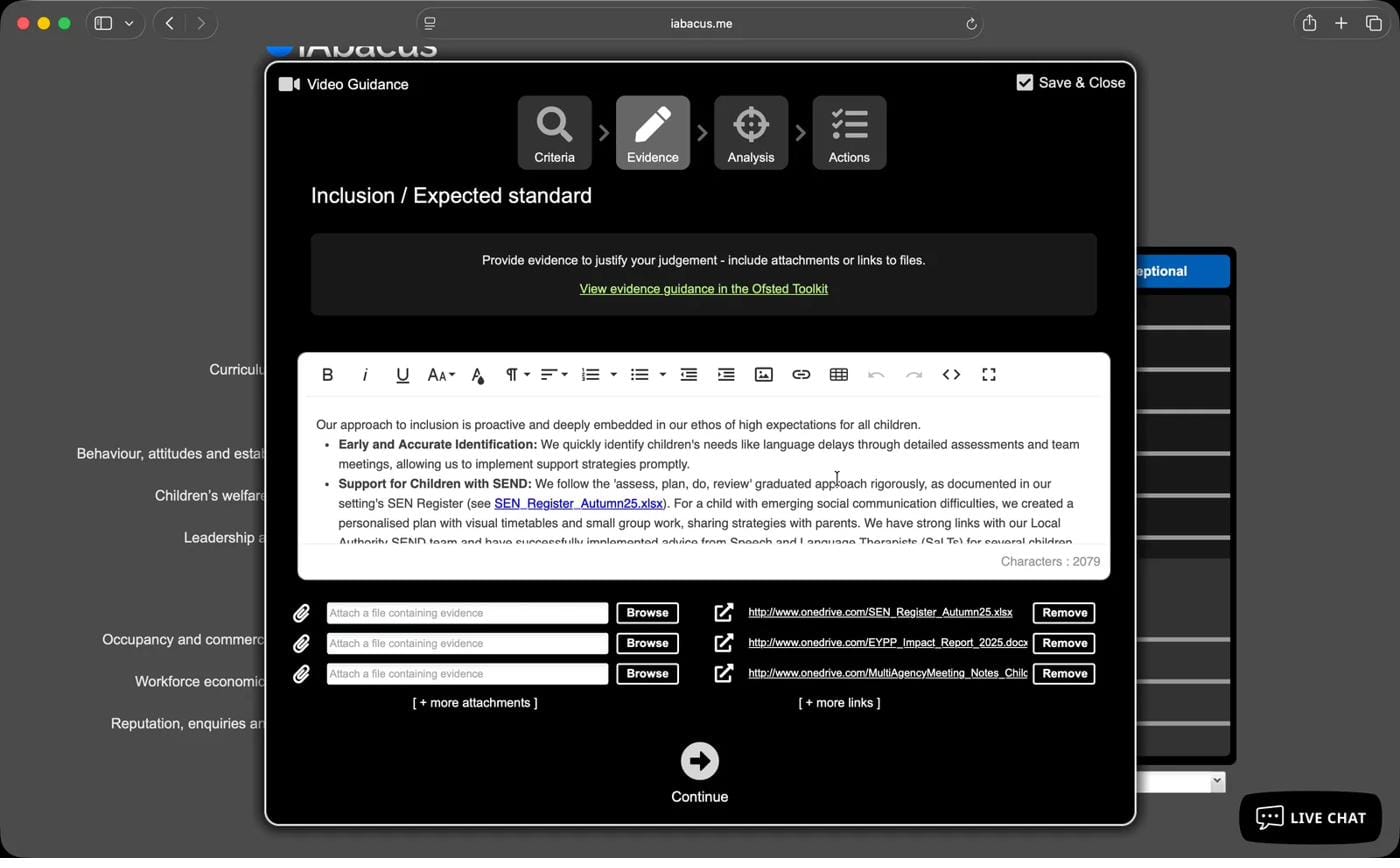
When a group leader clicks into a setting, that is what they see. Not just where the setting stands, but why.
Insight only counts if it is comparable
Here is the catch. Rich insight from one setting is useful. Rich insight from twelve settings, each written in a different format against different criteria, is almost impossible to act on.
You cannot compare what is not comparable. One manager's "good" is another manager's "fine". One setting's improvement plan runs to twenty pages. Another fits on a sticky note.
That is why a shared framework matters so much. When every setting evaluates against the Ofsted Early Years Inspection Toolkit — the same six areas, the same five-point scale, the same grade descriptors — judgements finally line up. Add your group's own areas, such as occupancy, workforce and reputation, evaluated the same way, and the commercial picture lines up too.
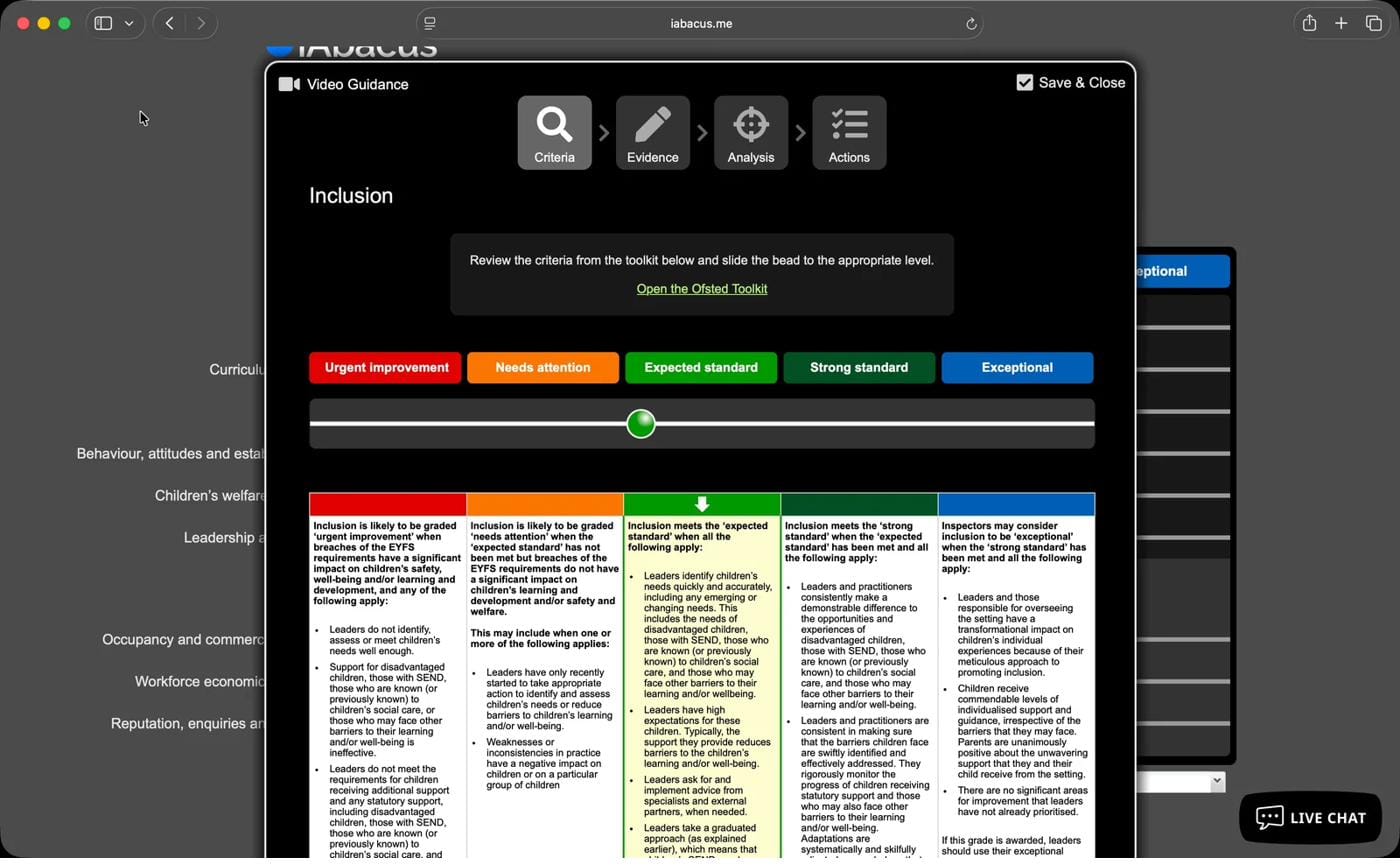
Now a difference between two settings means something. And a decision based on that difference is a decision you can defend.
Five decisions insight makes better
As each setting completes its evaluation, the Nursery Group Dashboard builds itself. No chasing. No compiling. No reports written upwards. Every setting in one view — and one click away from the full story behind any judgement.
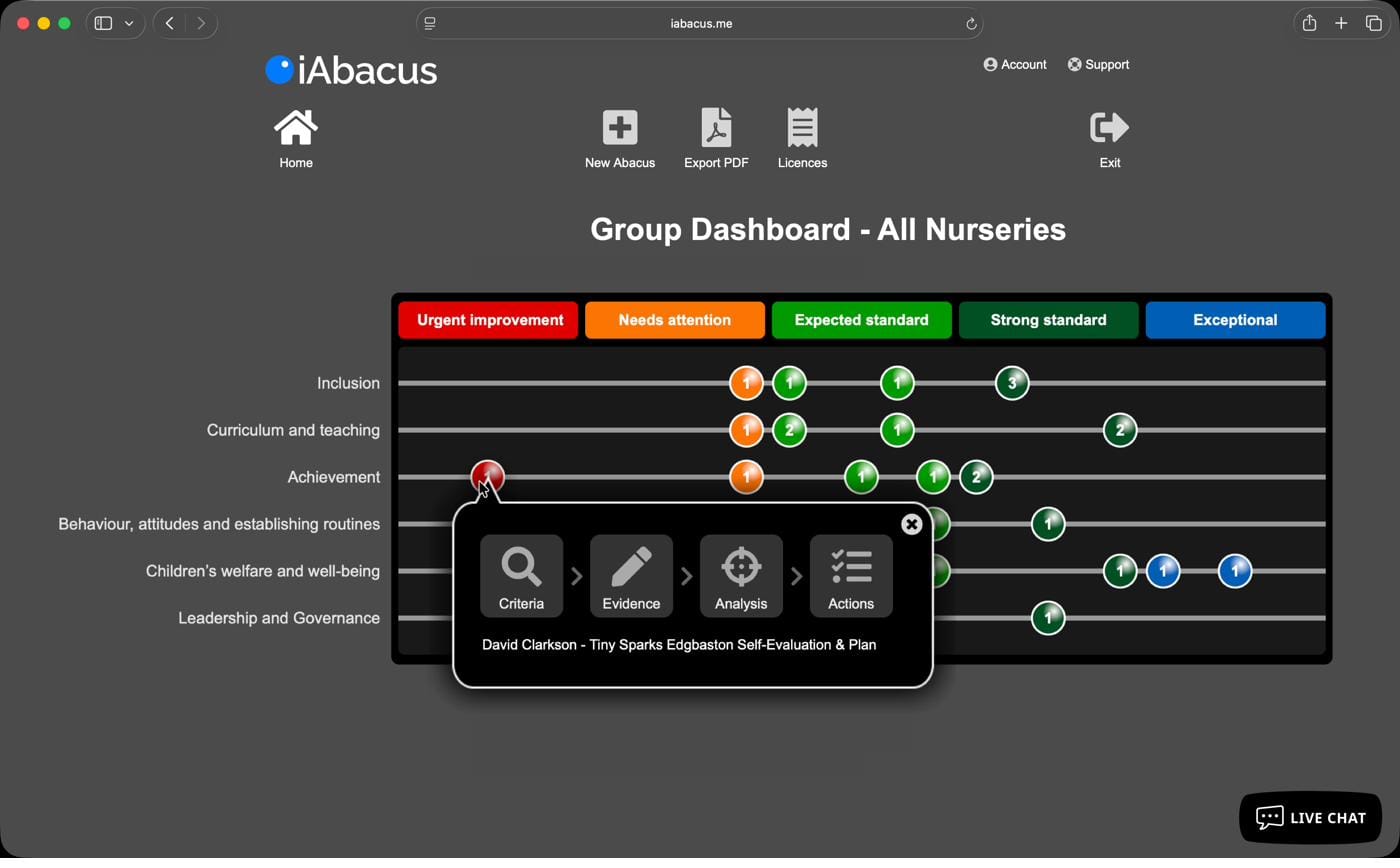
Here is what that changes in practice.
1. Where support goes. Instead of spreading the quality team evenly, or sending them wherever the latest concern came from, you can see which settings are sitting at Needs Attention, in which areas, and what their managers say is holding them back. Support goes where it will make the most difference.
2. Where excellence is shared. When one setting is Strong or Exceptional in curriculum and teaching, you can see exactly what they are doing — the evidence and the helping factors. That practice can be shared with the settings that need it most, rather than staying locked in one building.
3. Where training budget is spent. When three settings all name the same hindering factor — inexperienced room leaders, say, or inconsistent key person practice — that is not three local problems. It is one group-wide training need.
4. What you tell the board. A board meeting built on a live, evidence-backed picture is a very different conversation from one built on a spreadsheet and a few anecdotes. Strengths, risks and actions, all visible and all explained.
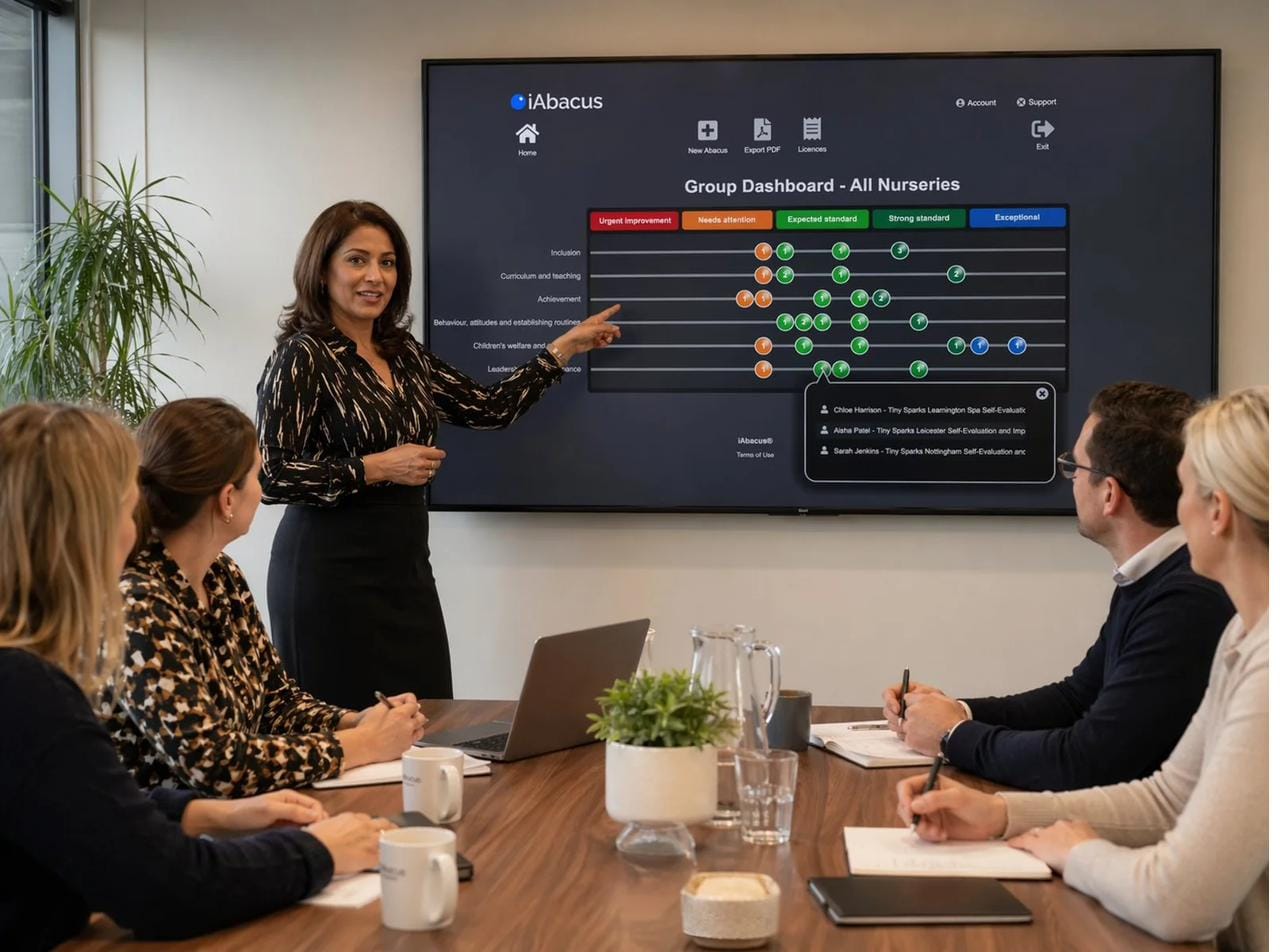
5. When you are ready to grow. Opening or acquiring a setting stretches a group. Insight tells you whether your current settings are stable enough to absorb that stretch — and which managers have the strength to support a new one.
Insight that is honest, not performed
There is one more condition, and it is the most important. Insight is only useful if it is honest.
If managers feel their self-evaluation is a report card for head office, they will write what head office wants to read. The picture looks tidy. The decisions built on it are wrong.
That is why iAbacus is built for the manager first. They evaluate for themselves, not for head office. They make an honest judgement, test it against the criteria, gather the evidence, analyse what is helping and hindering, and build a plan they actually own. The group dashboard is a by-product of that work — not the reason for it.
Managers engage because it helps them run their setting. Group leaders get insight they can trust because nobody was performing for them. Empower your nursery managers. Inform your group leaders.
Decide with confidence
Group leaders will always have to make decisions under pressure. That does not change.
What can change is what those decisions rest on. Not instinct. Not the loudest voice. Not a spreadsheet from last term. A live, honest, comparable picture of every setting — what is happening, why, and what is already being done about it.
That is the difference between data and insight. And it is the difference between hoping you made the right call and knowing you did.
Know your group. Really know it.
Find out more
See how the iAbacus Nursery Group Dashboard turns honest setting-level evaluation into group-level insight — across Ofsted quality and the commercial measures that matter — at ngd.iabacus.com.
Any nursery group can trial the complete solution in one setting at no cost. No obligation, no contract, and no catch.


