


How one headteacher turned school self-evaluation into a whole-staff conversation — and why it changed everything.
We recently had the privilege of meeting with a primary school headteacher who was fairly new to her post. Like many school leaders stepping into headship, one of her biggest concerns before taking the role had been Ofsted — specifically, how she would prepare her school for inspection, manage the self-evaluation process, and keep on top of an improvement plan that was both meaningful and manageable.
She needn't have worried. And the reason? iAbacus.
Her multi-academy trust had invested in iAbacus for every school across the trust, giving her access to the platform in the months before she took up her post. What followed, she told us, had completely changed her relationship with school improvement.
From Anxiety to Confidence
"It clarified my thinking," she said — and that, in a nutshell, is what iAbacus is designed to do.
The Ofsted toolkit can feel daunting, especially for leaders who are new to the role or new to headship. But iAbacus takes that framework and makes it something you can actually work with — visually, intuitively, and in your own professional language. Rather than wading through lengthy documents or wrestling with complex compliance systems, this headteacher found herself with a clear, structured process that helped her understand where her school stood, what the evidence was saying, and what needed to happen next.
The result was a headteacher who felt genuinely confident — not just in the tool, but in her own professional judgement.
The Moment That Stood Out
While everything she shared was encouraging, one detail stood out above all others.
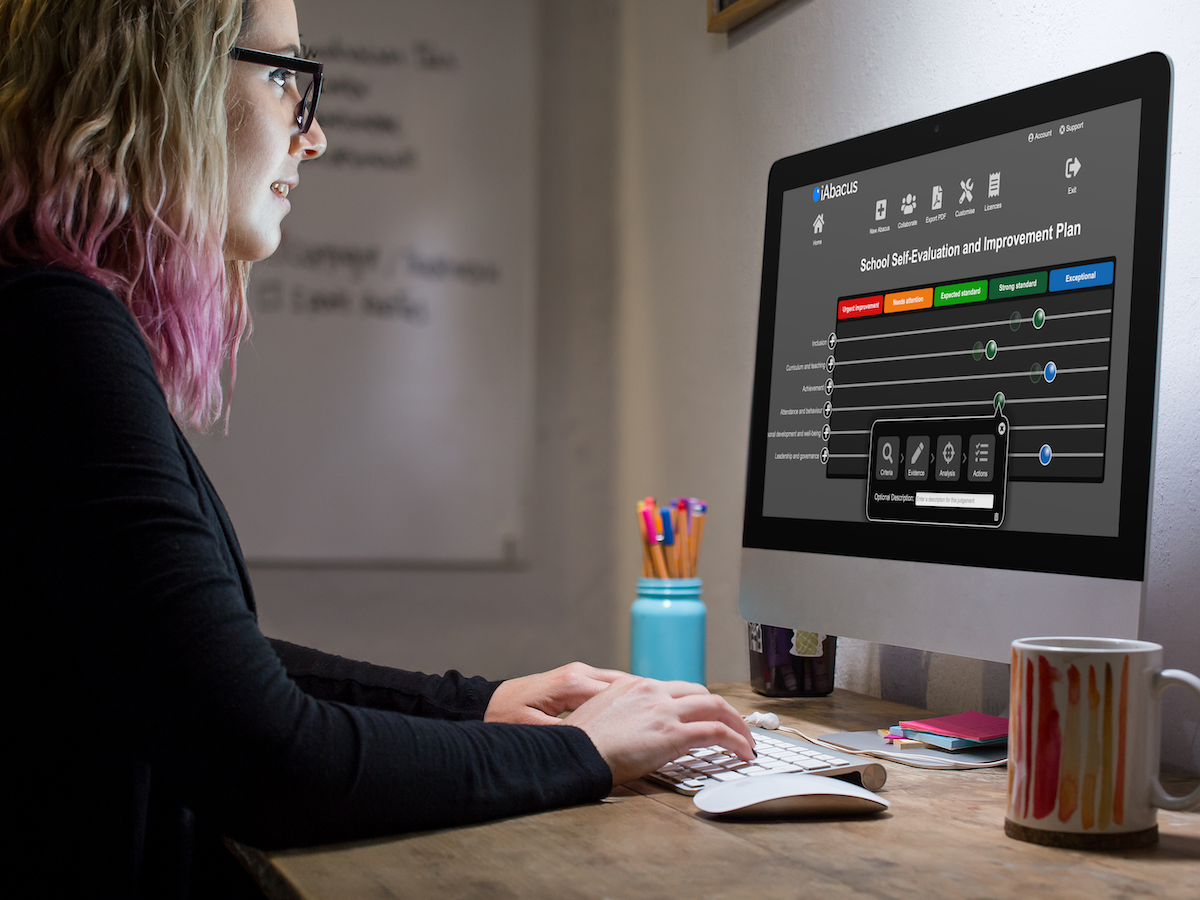
She described a staff session where she brought iAbacus up on the interactive whiteboard and opened it up to the whole room.
There on the screen were the current judgements, the supporting evidence, and the helping and hindering factors she had been building. Rather than presenting these as a finished document for staff to receive, she invited her colleagues to look, to question, and to contribute.
What happened next was remarkable.
Staff who might otherwise have sat quietly began to engage. Perspectives emerged that hadn't come to the surface before. Insights were shared that would simply never have been raised had it not been for the structure and clarity that iAbacus provided. The session was focused, productive, and — by her own description — incredibly beneficial.
This is the iAbacus difference. The platform doesn't just support school leaders working alone at a desk. It creates the conditions for genuine professional dialogue. When your self-evaluation is clear, visual, and easy to follow, it becomes something you can share with confidence — on a screen, in a room, in real time.
Why Collaboration Changes Everything
There's a reason iAbacus has been developed and refined over more than 50 years, through the evolution of data dashboards, changing inspection frameworks, and the rise of artificial intelligence in schools.
At its heart, iAbacus is built on a coaching model. It is empowering and supportive by design. It starts with professional judgement — yours, and your colleagues' — rather than replacing it with metrics or imposing conclusions from outside.
When a headteacher can bring iAbacus into a staff session and invite colleagues to contribute freely, something important happens: ownership shifts. School improvement stops being something done to staff and becomes something done with them. The evaluation becomes shared. The plan becomes collective. The journey becomes everyone's.
This isn't a feature that was bolted on. It's what iAbacus was always built to do.
What This Means for Your School
Whether you are a headteacher stepping into a new role, a senior leader looking to refresh your self-evaluation approach, or a trust leader seeking consistency across multiple schools, iAbacus offers something that most tools simply cannot: a process that is as powerful in a room full of colleagues as it is when you're working alone.
The key benefits are clear:
- Clarity from day one — the Ofsted toolkit becomes easy to navigate and use as the basis for your school self-evaluation and improvement plan
- Built for collaboration — bring it to any screen, share it with any team, and invite real contributions in real time
- Evidence-led, not compliance-driven — professional judgement sits at the centre, supported by evidence and structured reflection
- Trusted and proven — grounded in over 50 years of development in schools, and refined through every shift in the educational landscape
- Empowering for staff — when colleagues can see the evaluation clearly and contribute meaningfully, engagement and ownership follow naturally
The Core Essentials Still Matter Most
Amidst all the latest developments in schools — new software, new inspection frameworks, the increasing pace of change — the fundamentals of school improvement remain unchanged. Trusting the values and professional judgement of colleagues is one of the most powerful drivers of improvement there is.
iAbacus doesn't try to replace that. It makes it easier. It gives it structure, visibility, and momentum.
When we hear feedback like this from schools using iAbacus, it only reaffirms why we do what we do.
Want to See It in Action?
If you're curious about how iAbacus could support your school — whether you're just beginning your self-evaluation journey or looking to open it up to a wider team of colleagues — we'd love to hear from you.
Get in touch today and one of our team will be happy to provide a personal demonstration of iAbacus, walk you through how it works in practice, and explore how it could be used across your school to create a streamlined, collaborative self-evaluation and improvement planning process that brings your whole team on board.
👉 Contact us to find out more or arrange a demonstration
iAbacus is used by thousands of schools, multi-academy trusts, and educational organisations across the UK and beyond. Find out more at www.iabacus.com


