


How iAbacus helps Northern Ireland schools move from a 20-page document to a working improvement plan — with a short video walk-through.
The Education and Training Inspectorate's Empowering Improvement: New Framework for Inspection is a thoughtful piece of work. Co-designed with schools. Lower stakes. No published performance gradings. Five core questions at the centre, nine contributory areas around them, and a clear invitation to use the indicators as a tool for the school's own self-evaluation.
It's a framework that schools genuinely want to use — not just to prepare for inspection, but to drive improvement year-round. The challenge is the practical one. How do you take a 20-page document and turn it into something a senior leadership team can actually sit around and work through together? Something that surfaces honest reflection, holds the evidence, captures what's helping and hindering, and converts all of it into a credible plan?
That's what iAbacus is built for. And we've now mapped the ETI framework directly into the platform — so any school in Northern Ireland can pick it up and start using it tomorrow.
▶ Watch the 5-minute walk-through: iAbacus for Northern Ireland Schools — Self-Evaluation with the ETI Empowering Improvement Framework
We'd genuinely encourage you to watch that video before reading on. Five minutes will show you the tool in motion — and the rest of this article will make more sense once you have.
One screen, nine areas, an honest conversation
Open the abacus and the ETI's nine contributory areas appear as nine rows down the left, with three columns across the top: Less effective (red), Improving (amber), Effective practice (green).
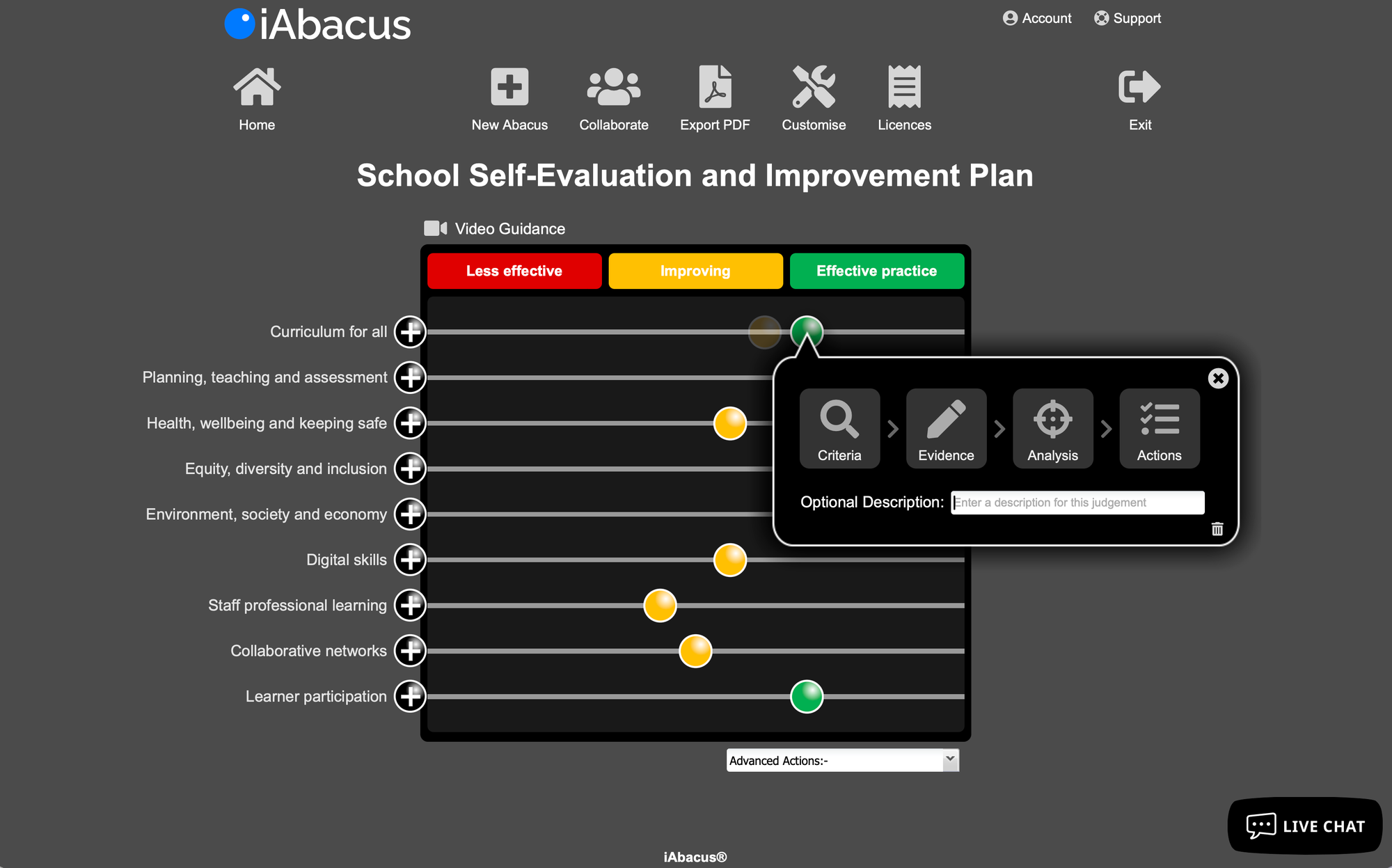
Each row is a bead you slide. That single, kinaesthetic action does something quietly important: it forces a judgement before the conversation gets bogged down in qualifications and caveats. Where, honestly, do we sit on Curriculum for All right now? On Health, Wellbeing and Keeping Safe? On Learner Participation?
The traffic-light scale gives an immediate, shared visual across all nine areas — a single screen any leadership team, governing body or department can read at a glance. And every row not on green is, by definition, a starting point for improvement.
The four-step process behind every bead
Place a bead and iAbacus opens a guided four-stage process. The same sequence for every contributory area, every time:
- Criteria — check your judgement against the ETI's own indicators
- Evidence — justify it with proof, not opinion
- Analysis — diagnose what's helping and what's hindering
- Actions — plan what, who, success and when
It's a logical sequence, and the discipline of working through it in order is the point. Schools often jump straight from "we have a problem" to "here's the action plan". iAbacus deliberately puts two steps in between — evidence and analysis — and that's where the strategic thinking actually happens.
Criteria — the inspectorate's language, in front of staff
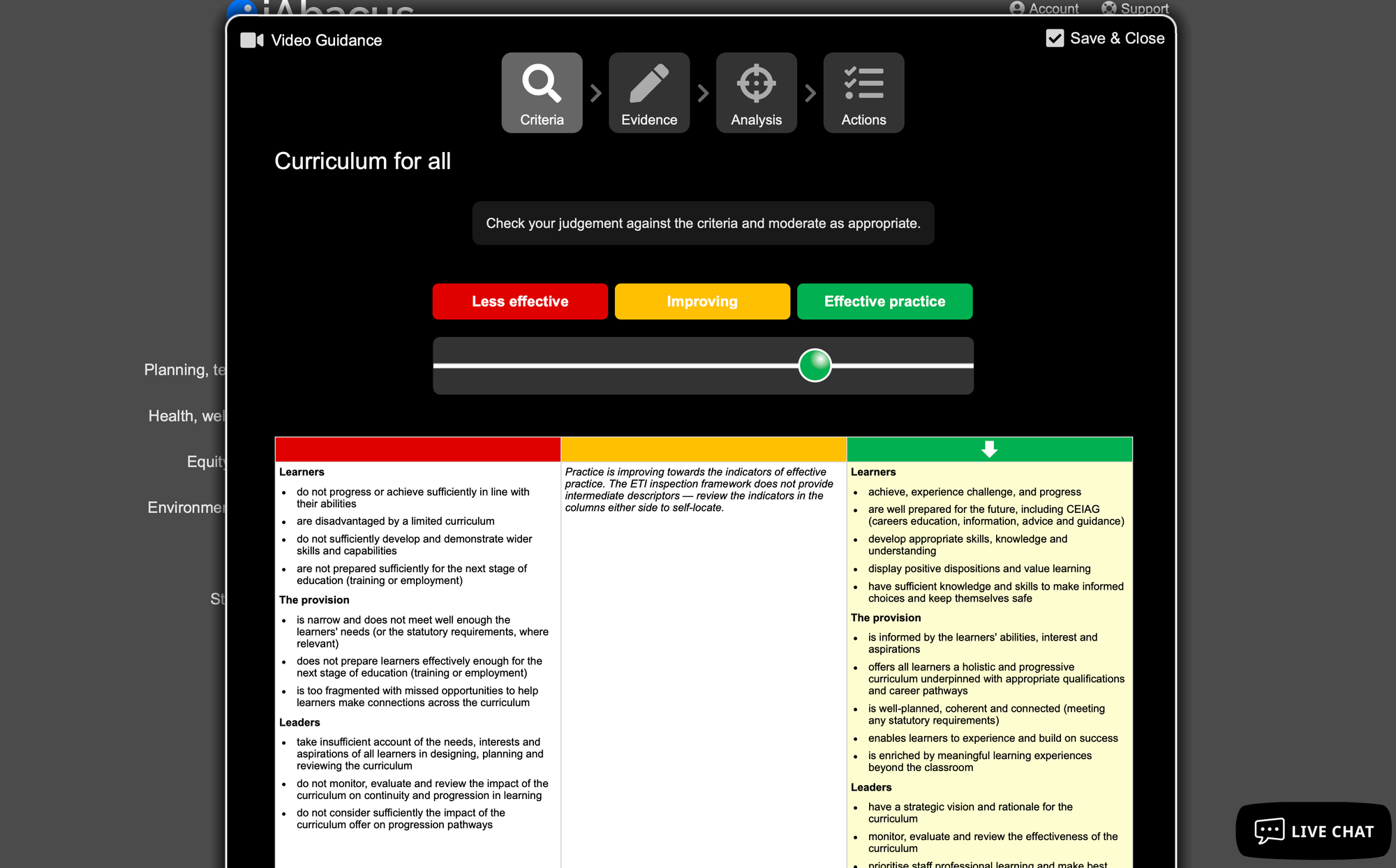
When you slide the bead, the matching column highlights and displays the ETI's indicators verbatim — no paraphrasing, no interpretation that could drift from the source. The indicators are grouped under three audiences (Learners, The provision, Leaders), exactly as the framework is written.
That choice matters. Staff are reading the inspectorate's own words during their own self-evaluation, which means the school's internal judgement is aligned directly with the framework against which the inspectorate will evaluate them. The Improving column intentionally contains no fabricated criteria — the ETI doesn't publish intermediate descriptors, and we don't invent them. Instead, it invites you to compare your practice against the indicators on either side and self-locate.
It's a small thing that makes a big difference. There's no translation layer between the framework and the conversation.
Evidence — signpost it, don't drown in it
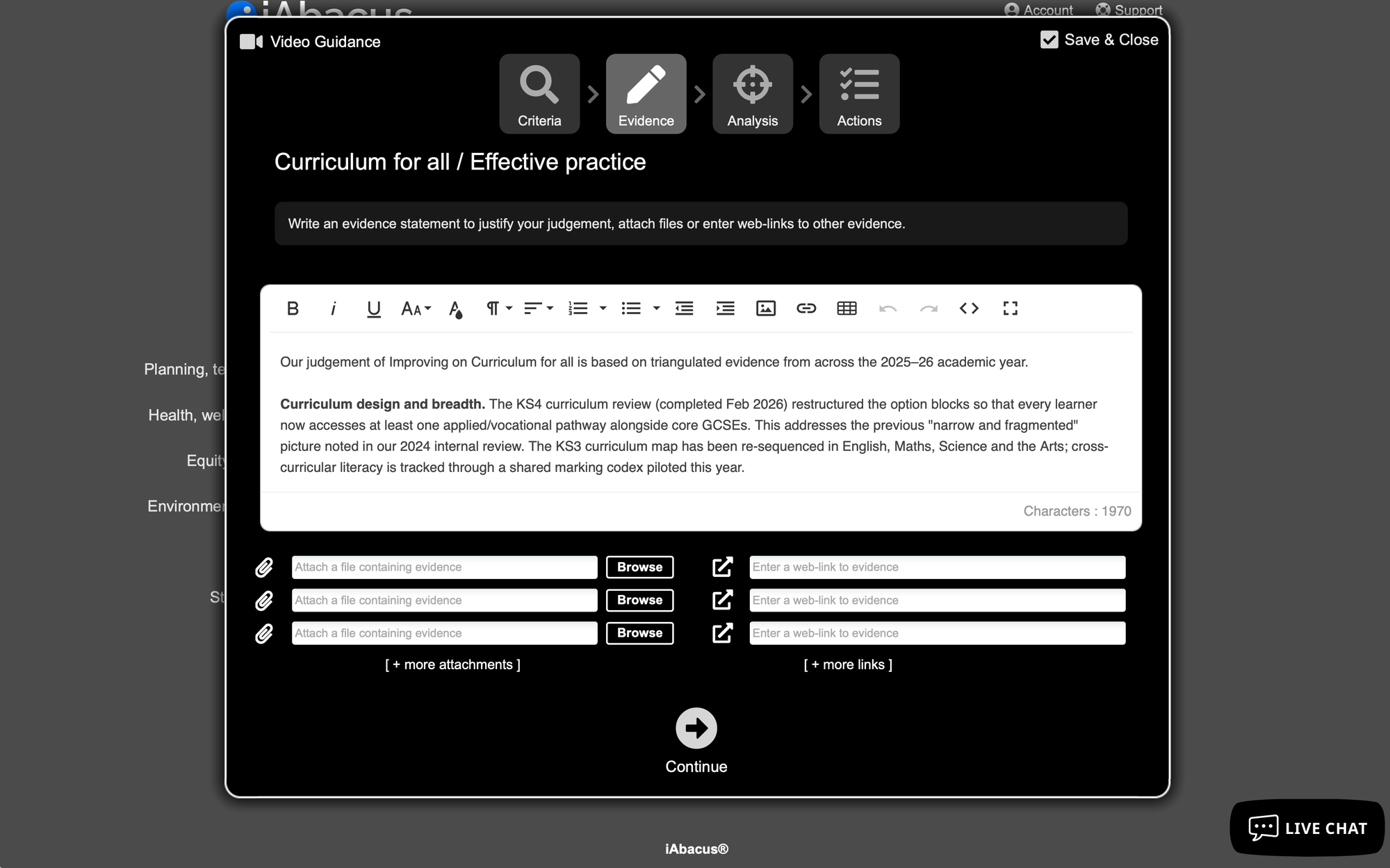
A judgement without proof is an opinion. The evidence stage is where the school justifies its position — but the watchword, as the video puts it, is signposting. Concise. Clear. Evaluative.
Schools often have mountains of data. iAbacus deliberately doesn't ask you to pour all of it in. Write a short evidence statement. Attach the files that matter — policies, data extracts, pupil voice surveys, observation summaries. Add web-links to existing material on the school site, in shared drives, on partner platforms. Use the school's existing documentation, exactly as the new ETI framework encourages.
The goal isn't a comprehensive archive. It's a triangulated picture that another professional could read in two minutes and trust.
Analysis — the step that changes everything
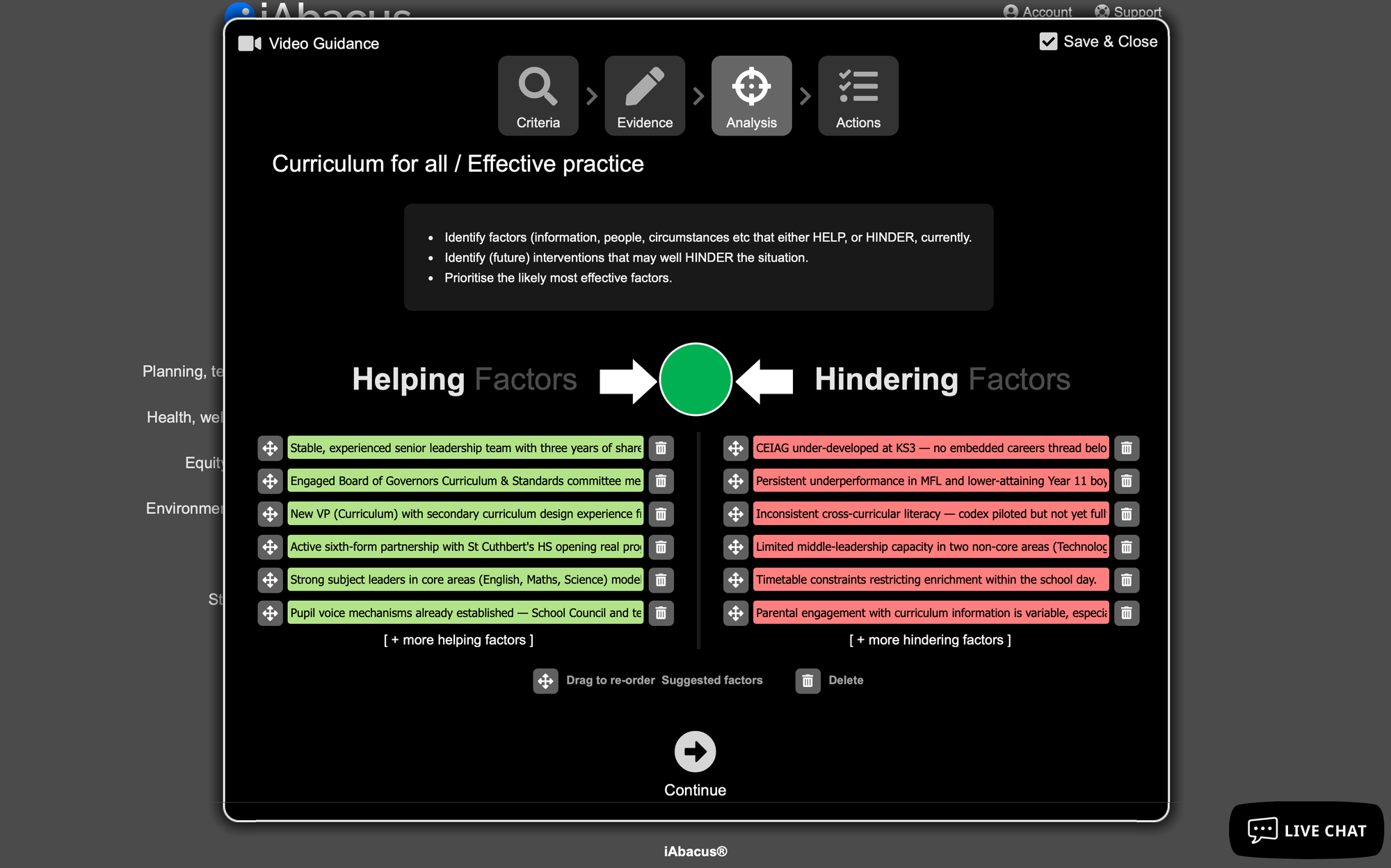
This is the stage that most distinguishes iAbacus, and the one schools tell us has the biggest cultural impact.
On the left of the screen: helping factors. The people, policies, practices and resources that have got the school to where it currently is. On the right: hindering factors. The barriers, the constraints, the patterns not yet broken.
This is force-field analysis, drawn from Kurt Lewin's work and refined over decades of school improvement practice. It does two things at once. It celebrates what's working — too often skipped over in self-evaluation, which has a habit of focusing only on problems. And it forces an honest naming of what's getting in the way, before anyone reaches for a solution.
A common mistake is to write actions in the hindering column ("training required on the new system"). That's not a hindering factor — it's a guess at one solution. The hindering factor might actually be that the system is too slow, or not fit for purpose, or that nobody has time to learn it. Naming the situation accurately is what opens up the right action — and often it's a different action from the first one anyone would have reached for.
Factors can be dragged to prioritise them, hidden if they're not within the school's control, and revisited as circumstances change.
Naming the situation accurately is what opens up the right action — and often it's a different action from the first one anyone would have reached for.
Actions — what, who, success, when
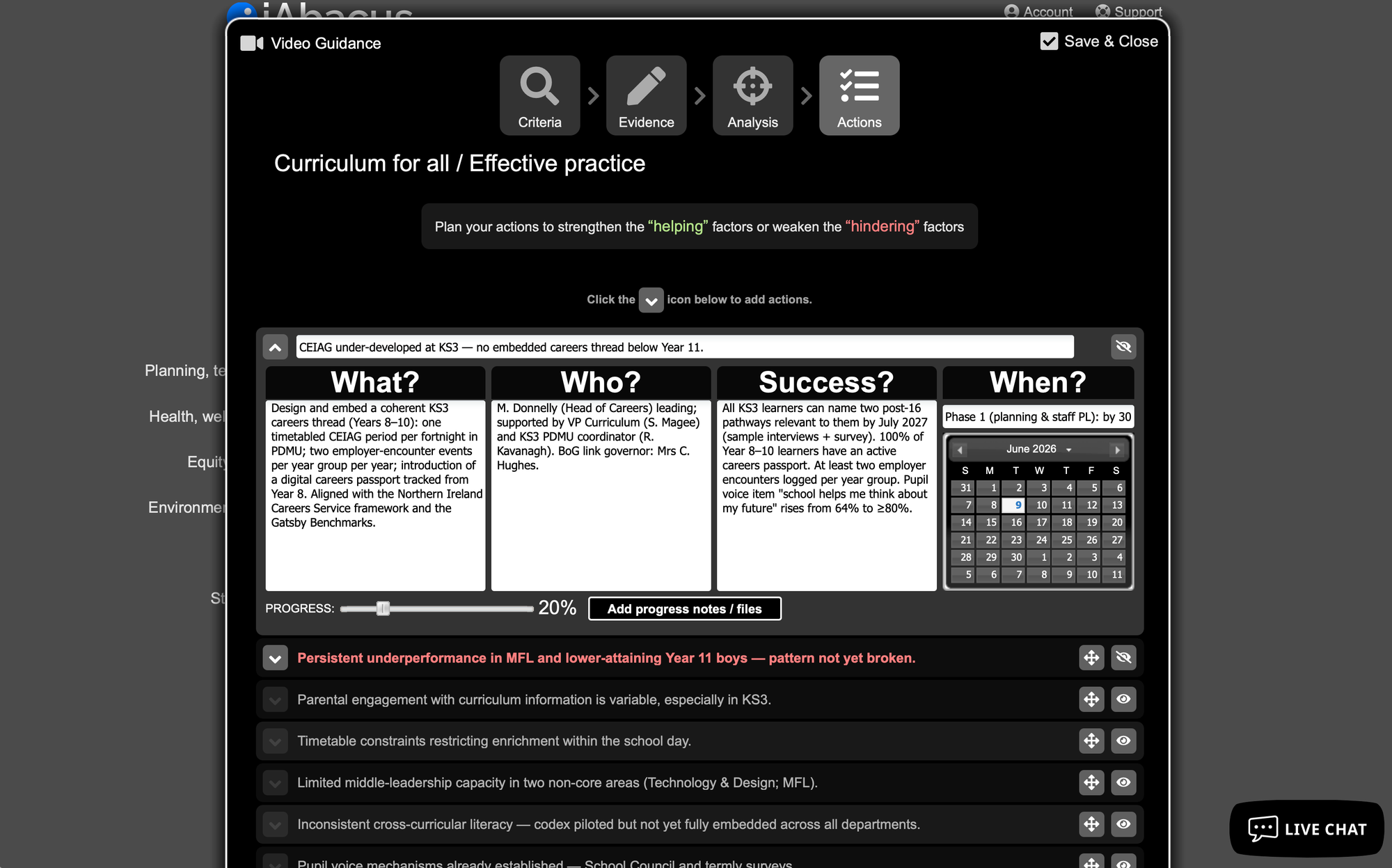
For each prioritised factor, an action planning strip opens with four fields:
- What needs to be done
- Who is responsible
- How will we know it's been successful
- When will it be done by
Four fields, deliberately. No more. Decades of work on improvement planning have shown these are the questions that matter — and that longer templates almost always produce worse plans, not better ones.
Each action also has a progress slider, a notes field, and the ability to attach files or links as the work unfolds. The plan is designed to be worked on, not filed away. As actions progress, the slider moves; as evidence of impact accumulates, it goes into the notes; and when enough has changed, you place a new bead further to the right and the older judgement remains visible behind it as a record of the journey.
Why this matters for NI schools right now
The ETI has been explicit that the new framework is meant to be complementary to ongoing self-evaluation, not a separate event that schools brace for once every few years. Three things follow from that, and iAbacus is designed for all three.
Self-evaluation needs to be continuous. A document on a shared drive isn't continuous. A live abacus that any member of SLT, any subject leader, any governor can open and update is. New evidence goes in as it arrives. New judgements get placed when the picture changes. The history stays visible.
Inspection is professional dialogue, not paperwork inspection. The new framework places strong emphasis on professional dialogue with inspectors and on using the school's existing documentation as evidence. iAbacus produces a single, visual, interactive PDF report that holds the judgement, the evidence, the analysis and the actions for every bead. It's bespoke to the school by design — exactly what the new conclusion format expects.
Highly effective practice needs to be shareable. The ETI wants effective practice identified, reported and shared. iAbacus makes that straightforward — a department can share its abacus with the rest of the school, two schools in a partnership can compare theirs, and a federation can stack abacuses to see patterns across sites. Good practice becomes visible and repeatable.
A whole-school tool, a department tool, a governance tool
Although the screenshots in this article and the video show whole-school self-evaluation against the ETI framework, that's only one use. Because iAbacus is fully customisable, the same process — judge, evidence, analyse, act — works for:
- A subject department reviewing its own provision
- A pastoral team auditing safeguarding or attendance
- A governing body taking strategic stock against its own priorities
- An individual leader's professional development plan
- A SENCo evaluating provision against statutory requirements
The ETI template is one of more than 20 ready-made templates in iAbacus, and any school can build its own from scratch in minutes.
Try it for your school
If you lead a school, college or training organisation in Northern Ireland and you'd like to see iAbacus working with the ETI framework in your own context, we'd be glad to show you.
▶ Watch the walk-through video: iAbacus for Northern Ireland Schools
🌐 Book a personal demo or start a free trial: www.iabacus.com
💬 Questions? Use the live chat on our website — we usually reply the same day.
The ETI says it is determined to "lower the stakes but raise the impact" of inspection. iAbacus is built on the same conviction: that the most powerful improvement comes from honest judgement, careful evidence, accurate diagnosis, and a plan that's actually worked on.
Try it on one bead. See where it takes you.


