


The new Ofsted Early Years Inspection Toolkit, in force since November 2025, is the most thorough framework for evaluating early years provision that has ever existed. Six evaluation areas, graded on a five-point scale, with safeguarding as a separate judgement. For nursery managers and group leaders, it is a welcome improvement on the old handbook — clearer, more coherent, better designed for self-evaluation as well as inspection.
But for all its thoroughness, the toolkit has one honest limitation.
It evaluates the provision. It does not evaluate the business around the provision.
Ofsted cares about how well a setting cares for and educates the children who attend. The toolkit says so, explicitly and repeatedly. What it does not consider — because it was never designed to — is whether there are enough children attending in the first place. Whether the staff delivering that provision are stable or churning. Whether the setting has any new families coming through the door next term.
Those are not failings of the toolkit. They are outside its remit.
But they are very firmly inside the remit of any group leader running a business with two, twenty, or two hundred settings on the estate.
The dashboard that groups actually need
A group quality director who inherits a purely Ofsted-aligned dashboard inherits half a picture. They can see which settings are strong across inclusion, curriculum and teaching, achievement, behaviour and routines, welfare, and leadership. What they cannot see — at least, not in the same place, on the same framework, evaluated by the same people — is which settings are commercially thriving, which are commercially vulnerable, and which are sitting quietly on a problem that will become urgent in three months.
That second picture usually lives elsewhere. Occupancy reports from the management information system. Payroll data from finance. Google review scores someone pulls manually. Exit interview notes in a file that nobody reads. Agency spend buried in the monthly numbers. Recruitment pipeline health known only to the area manager who has been meaning to write it up.
Two pictures. Both partial. Neither connected. Both missing the thing that makes either of them genuinely useful — the professional judgement of the person running the setting, explaining what the numbers actually mean.
Three areas the Nursery Group Dashboard adds
The iAbacus Nursery Group Dashboard extends the Ofsted framework with three additional evaluation areas. Each follows the same structure as the Ofsted areas. Each is graded on the same five-point scale, from Urgent Improvement to Exceptional. Each is evaluated by the nursery manager with evidence, a force-field analysis of what is helping and hindering, and a specific action plan.
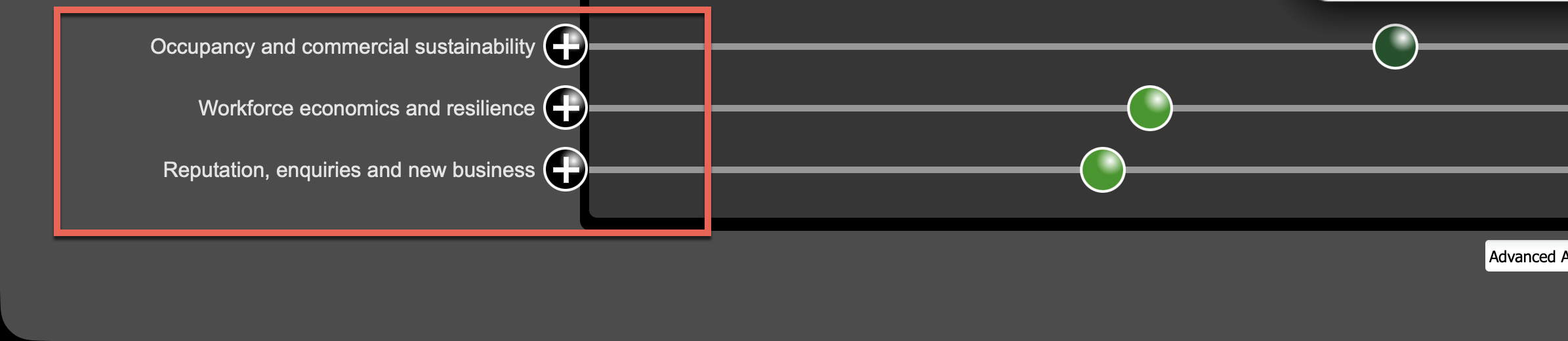
Occupancy and commercial sustainability
Whether the setting has the children, the mix, and the margin to continue providing high-quality care into the future. Occupancy rate against the group's benchmark. Enrolment pipeline from enquiry through to confirmed place. Retention patterns and mid-term leavers. The funded-to-private hours mix, and whether it works commercially given the 2025 funded hours expansion. The setting's position in its local market.
A manager knows these things. They know whether their baby room waiting list is real or theoretical. They know why the family in the pre-school room left last term and whether the same thing is about to happen again. The question is whether that knowledge is being captured anywhere a group leader can see it.
Workforce economics and resilience
Whether the setting has a stable, sustainable team that can deliver high-quality provision consistently over time. Ofsted's Leadership and Governance area evaluates staff well-being, workload, and professional learning — and rightly so. What it does not evaluate is the commercial workforce picture. Turnover rate. Agency spend as a proportion of payroll. Time-to-fill for open roles. Proportion of hires coming from referrals rather than recruitment agencies. The health of the internal progression pipeline.
Every group lives with the early years recruitment crisis. Bright Horizons publicly brand their colleague retention rates as sector-leading because they know retention is a commercial differentiator, not just a welfare indicator. A manager knows whether their team is stable. They know whether they are losing staff to the nursery down the road. The dashboard asks them to evaluate what that actually means for their setting.
Reputation, enquiries and new business
How the setting is perceived by prospective parents and the wider community, and how effectively it converts that reputation into enrolment. This is not the same as Ofsted's partnership-with-parents work, which evaluates the quality of communication with existing families about their own children. This is the commercial reputation — Google reviews, daynurseries.co.uk scores, referral rates, the enquiry-to-tour-to-enrolment funnel, community visibility, response times to online enquiries.
A manager knows exactly which recent review lifted their reputation and which complaint is still sitting unresolved on the first page of search results. They know which current parents are actively recommending them and which are quietly looking elsewhere. The dashboard brings that knowledge into view.
Why these three, and not a hundred others
The temptation with a flexible evaluation framework is to add everything. Margin, cost control, compliance burden, food standards, sustainability, diversity of workforce, parent engagement scores, social media reach. All real concerns. Most of them either duplicate something Ofsted already inspects, or are metrics a group CFO tracks remotely rather than areas a manager can meaningfully evaluate.
These three areas are the three that pass a simple test. Each one is genuinely outside the Ofsted framework. Each one is something a nursery manager can evaluate honestly with evidence. Each one is something a group board would ask about at a review meeting. And each one covers a distinct dimension of commercial performance — financial viability through occupancy, operational capacity through workforce, commercial growth through reputation.
Together with Ofsted's seven areas, they give a group leader something that has not existed before. A single, coherent, live picture of every setting in the group, across every dimension that matters — the quality of the care, and the health of the business delivering it.
The opportunity for group leaders
A group that deploys a dashboard covering only the Ofsted areas has a powerful tool for inspection readiness and quality assurance. That is real value. But it stops short of what a group leader actually needs to make decisions about where to invest, where to intervene, and where to protect.
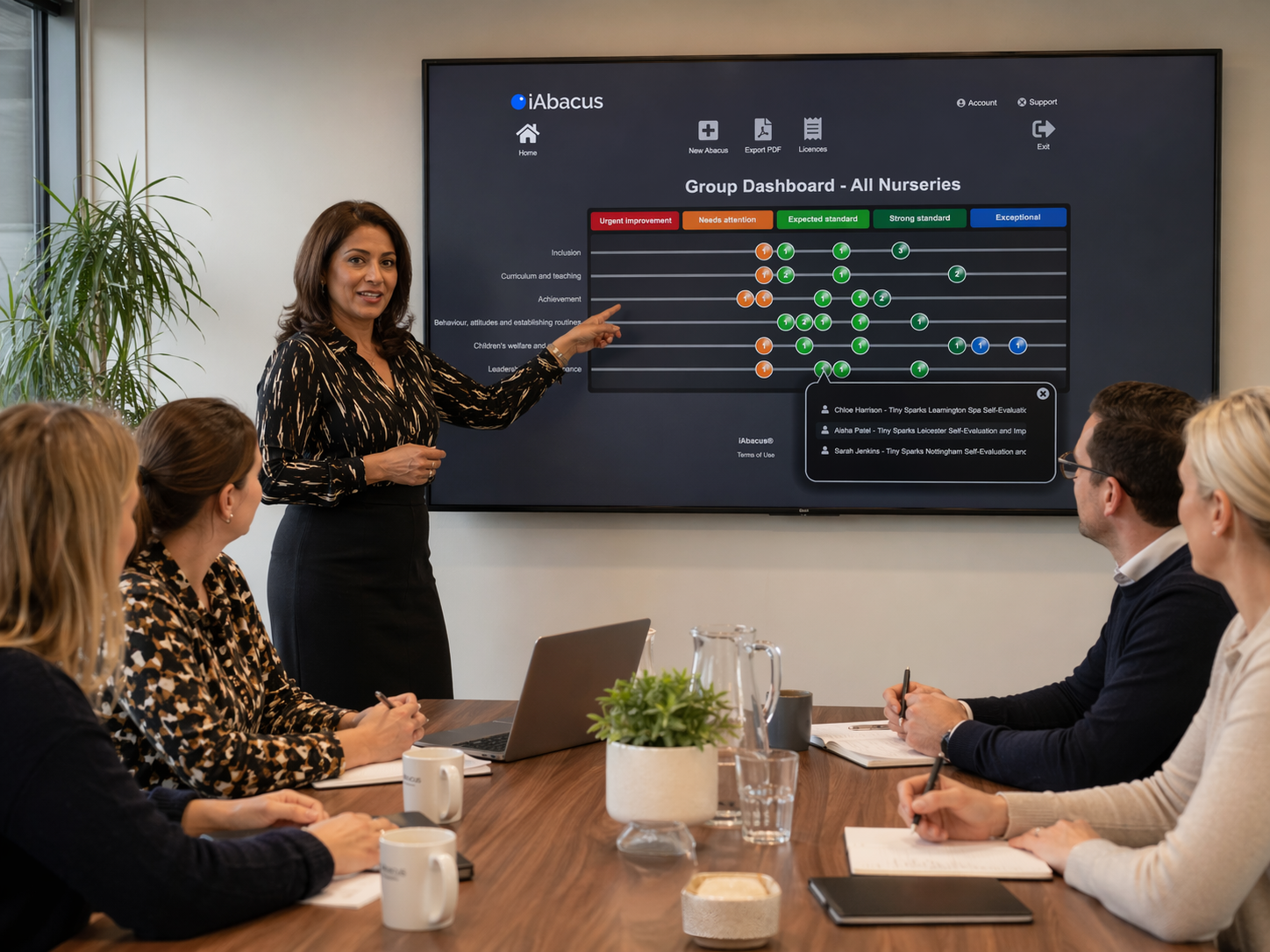
A group that deploys the full ten-area dashboard — seven Ofsted, three group-added — has something different. A complete picture. One framework. Every setting in the group evaluated honestly, consistently, and with an action plan for every area. The kind of panoramic view that makes strategic conversations at group level grounded rather than speculative.
The framework is the same. The process is the same. The managers do it once, for themselves, and the group dashboard builds from their work. Two wins, one framework, ten areas.
Find out more
See how the iAbacus Nursery Group Dashboard gives group leaders a complete picture of every setting — both the Ofsted view and the group view — at ngd.iabacus.com
Tags: #NurseryGroup #EarlyYears #GroupLeadership #NurseryManagement #OfstedEarlyYears #iAbacus #NurseryGroupDashboard #QualityAssurance #ChildcareBusiness #Occupancy #StaffRetention


