


Most schools have a system for appraising their teaching assistants. Fewer have one that actually works. Here's what's going wrong — and what a better approach looks like.
Ask a headteacher how their TA appraisal process works and you'll get a range of answers. Some schools have a clear, structured system. Many have something that resembles one — a form completed once a year, a brief conversation with a line manager, a target set and rarely revisited. A few will quietly admit that their TAs are appraised in whatever way is left over once the teaching staff have been dealt with.
None of this is born of indifference. Schools are busy, resources are stretched, and TA performance management has rarely attracted the same level of attention, guidance, or investment as teacher appraisal. The result is a workforce that is often left without the structured support, honest feedback, or genuine professional development that their role deserves — and that their pupils need them to have.
The good news is that fixing this does not require a wholesale overhaul of how your school works. It requires a clearer, more purposeful process — one that starts with the TA's own voice, not someone else's judgement.
What Most TA Appraisal Processes Get Wrong
The problems with TA appraisal tend to cluster around three familiar patterns.
It's inconsistent. In many schools, the quality of a TA's appraisal depends almost entirely on the line manager conducting it. A supportive, well-prepared middle leader might offer a genuinely developmental conversation. A busy class teacher with fifteen minutes before the bell might offer rather less. Without a shared framework, the process varies wildly — and TAs who most need structured support are often the least likely to receive it.
It's retrospective rather than developmental. Too many TA appraisals look backwards rather than forwards. They review what has happened rather than building a genuine picture of where the TA is now, what is helping or hindering their practice, and what needs to change. The result is a conversation that feels more like an assessment than a professional dialogue.
It leaves TAs out of the process. Perhaps most importantly, many TA appraisal systems still position the TA as the subject of the process rather than the author of it. Targets are set by line managers. Standards are applied from the outside. The TA's own honest view of their practice — their understanding of what is working, what is not, and what they need — is an afterthought, if it features at all.
This last point matters most. A TA who has no meaningful ownership of their own professional development is less likely to act on it. And a process that talks about professional growth without genuinely involving the professional is unlikely to produce any.
What a Better Process Looks Like
The iAbacus Teaching Assistant Reflection and Growth Plan was built to address exactly these gaps — drawing on the 2016 Professional Standards for Teaching Assistants as its foundation.
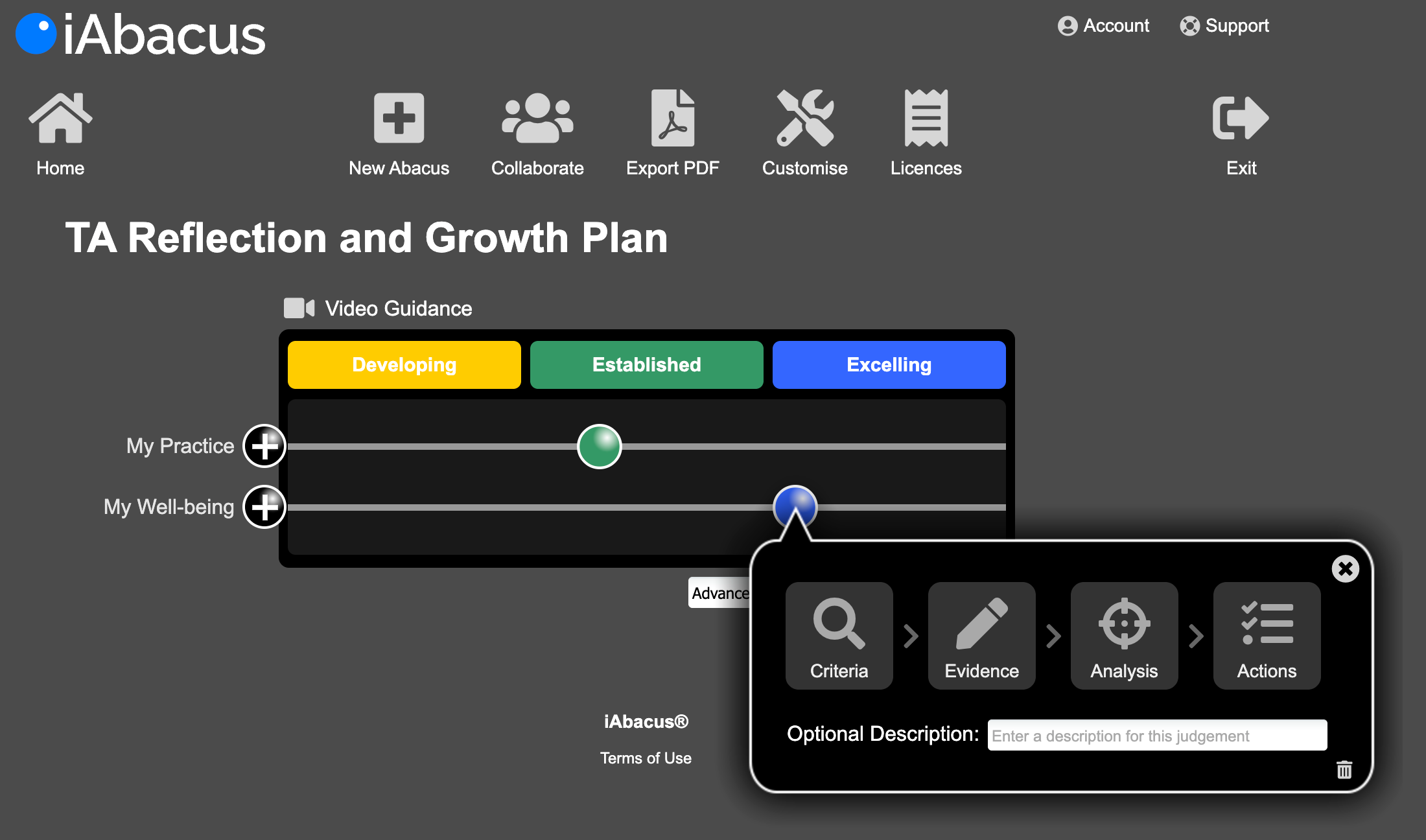
It is structured around two Areas: My Practice and My Well-being. The choice to keep it to two Areas is deliberate. TA appraisal processes that try to cover too much ground often collapse under their own complexity — producing lengthy forms that nobody reads and conversations that never get to what matters. Two clear, distinct Areas give TAs and their line managers a focused, honest framework that is genuinely usable.
Within each Area, the process follows the same four steps that underpin iAbacus across all its templates: Criteria, Evidence, Analysis, Actions.
The TA begins by positioning their own bead — making their own honest judgement about where they currently are across three levels: Developing, Established, and Excelling. They then check that judgement against clear, accessible criteria written in plain language that reflects the reality of the TA role. They gather and attach evidence. They analyse the factors that are helping or hindering their practice. And they plan specific actions to address what they have found.
The result is not a form. It is a professional narrative — built by the TA, from the inside out.
Why Starting With the TA's Own Judgement Matters
It is tempting to assume that self-assessment is inherently less reliable than external evaluation. In practice, the opposite is often true. TAs spend every day in the classroom. They know which pupils they are reaching and which they are not. They know when their interventions are working and when they are guessing. They understand better than anyone what is helping them do their job well and what is getting in the way.
A process that starts by asking TAs to articulate that understanding — honestly, without fear of judgement — unlocks something that a top-down appraisal cannot. It creates the conditions for a genuinely honest conversation, rather than a performance.
The four-step structure then ensures that honesty leads somewhere. Evidence grounds the self-assessment in reality. Analysis moves it from feeling to understanding. Actions turn understanding into a plan. And because the plan belongs to the TA — because they built it from their own reflection — they are far more likely to act on it.
The Picture It Gives Leaders
A better TA appraisal process is not just better for TAs. It is better for school leaders too.
When every TA in a school uses the same structured framework, headteachers and SLT gain something they rarely have: a consistent, comparable picture of where their support staff are professionally, and what the whole team needs. Using iAbacus's Overlay and Stack features, leaders can bring together the abacuses of all their TAs onto a single screen — seeing at a glance where practice is strong, where well-being needs attention, and where the most important conversations need to happen.
That picture, combined with the equivalent view from the teaching staff, gives a genuinely whole-school view of professional development — not just the teachers, but everyone who shapes the experience of pupils every day.
The Fix Is Simpler Than You Think
TA appraisal does not need to be complicated to be effective. It needs to be consistent, it needs to be honest, and it needs to start with the TA's own voice. A simple, structured tool that does all three — built on recognised professional standards and easy enough for any TA to use — is not a luxury. It is the baseline.
The iAbacus Teaching Assistant Reflection and Growth Plan was built to be exactly that.
If you'd like to talk through how this could work in your school, we'd love to have an informal chat. No pitch, no pressure — just a conversation about your school and whether iAbacus might help. Book a time that suits you at meet.iabacus.com


