


Artificial intelligence is everywhere in education right now. It is summarising documents, generating reports, analysing assessment data, producing instant overviews of school performance. The promises are significant — save time, reduce workload, surface insights that would take hours to find manually.
Some of those promises are real. But there is a question worth asking before education rushes to hand its improvement planning over to algorithms: what kind of intelligence actually drives school improvement?
The answer — built on fifty years of research and the experience of thousands of schools — is clear. And it is not artificial.
What AI is good at — and what it isn't
AI is exceptionally good at processing large volumes of information quickly. It can identify patterns in data, generate summaries, produce draft documents, and surface connections that a human reviewer might miss or take much longer to find.
What AI cannot do is understand a school from the inside.
It cannot know that the reason attendance has dipped in Year 9 is because of a specific set of circumstances affecting a particular cohort — circumstances that the pastoral lead has been quietly managing for months. It cannot understand that the curriculum and teaching judgement is complicated by a staffing situation that the headteacher is in the process of resolving. It cannot recognise that what looks like a weakness in the data is actually a school mid-improvement, with a clear plan in place and evidence of early progress.
AI works with information. School improvement works with understanding. Those are not the same thing.
The most valuable intelligence in school improvement is human
iAbacus was designed on a conviction that has been tested and validated over five decades of research and practice: the most powerful starting point for improvement is the honest, evidence-backed professional judgement of the people closest to the work.
Not a data summary. Not an automated analysis. The genuine, contextual, nuanced insight of a headteacher who knows their school — who knows its history, its community, its strengths, its pressure points, and what is genuinely happening behind the numbers.
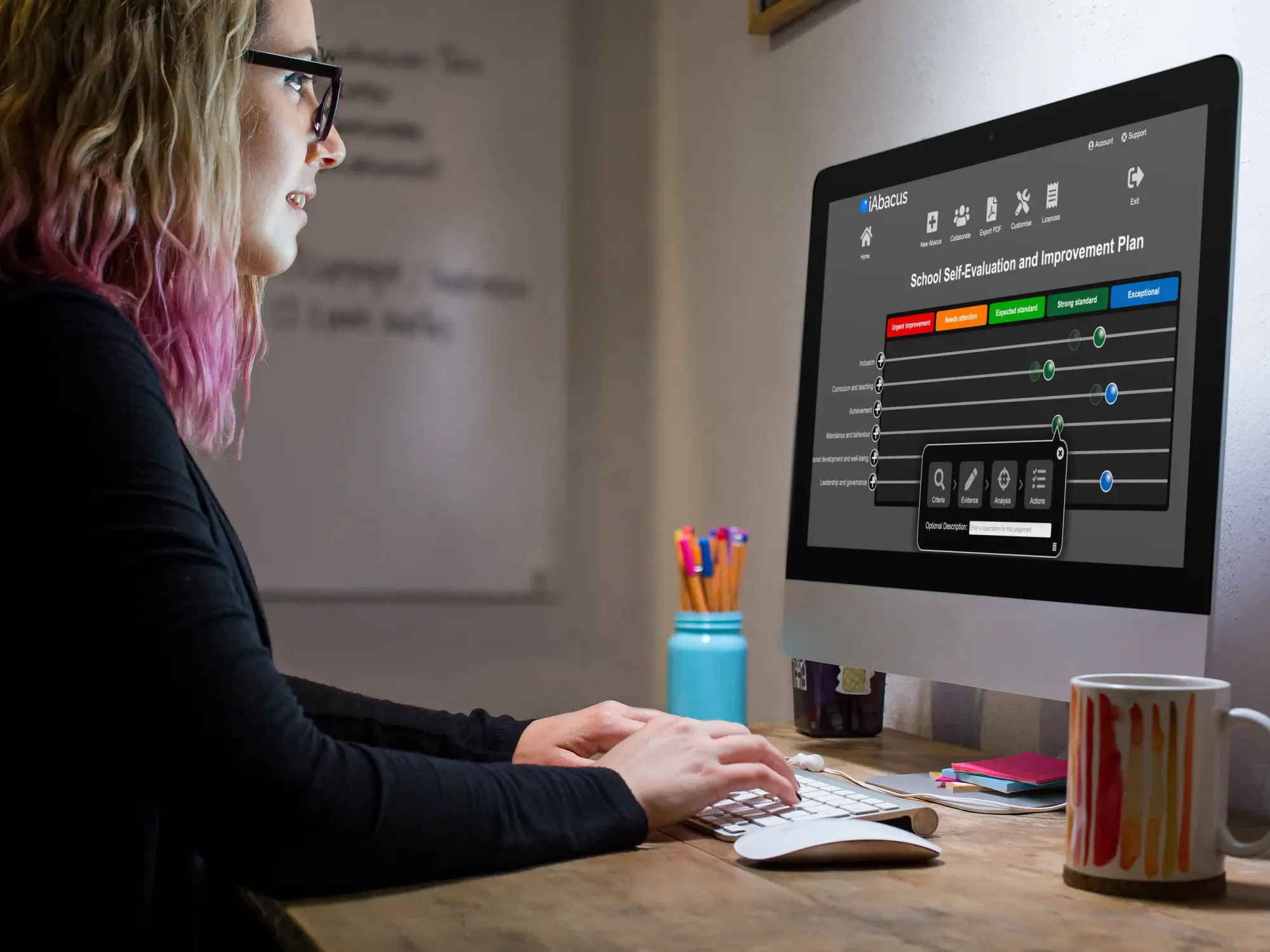
iAbacus structures and amplifies that human intelligence. It guides a leadership team through an honest evaluation of their school — making judgements, checking them against criteria, gathering evidence, identifying what is helping and hindering their performance, and building a focused action plan. At every stage, the professional is in the lead. The tool supports their thinking; it does not replace it.
The result is not a data point. It is a professional evaluation — honest, evidence-backed, and rooted in the genuine understanding of the people who know the school best. And it comes with an action plan.
What this looks like in practice
Here is what a headteacher and their senior leadership team actually do in iAbacus.
They evaluate their school across each of the six Ofsted evaluation areas — Inclusion, Curriculum and teaching, Achievement, Attendance and behaviour, Personal development and well-being, and Leadership and governance. They slide a bead to indicate where they believe their school currently stands. That initial judgement is then checked against the criteria in the new Ofsted inspection toolkit. Evidence is attached — documents, data, lesson observations, pupil voice surveys — to support and validate the position.
And then comes the step that separates iAbacus from any data system: the force-field analysis. What is helping this school perform at the level it does? What is hindering it from going further? And what specific, targeted actions will address those factors?
This is human intelligence at work. Structured, guided, and captured in a way that makes it actionable — but fundamentally human.
Where AI and human intelligence work best together
This is not an argument against AI. It is an argument for using it in the right place.
AI can help a headteacher draft a document faster. It can surface patterns in data that inform a conversation. It can reduce the administrative burden that currently consumes too much of every school leader's time. These are real benefits and they matter.
But the judgement — the honest, evidence-backed, contextually informed professional evaluation of where a school stands and what it needs — that must come from the people inside it. That is not a limitation. That is the point.
A trust leader looking at an AI-generated summary of their schools is looking at processed information. A trust leader looking at the iAbacus Report Card Dashboard is looking at something categorically different.
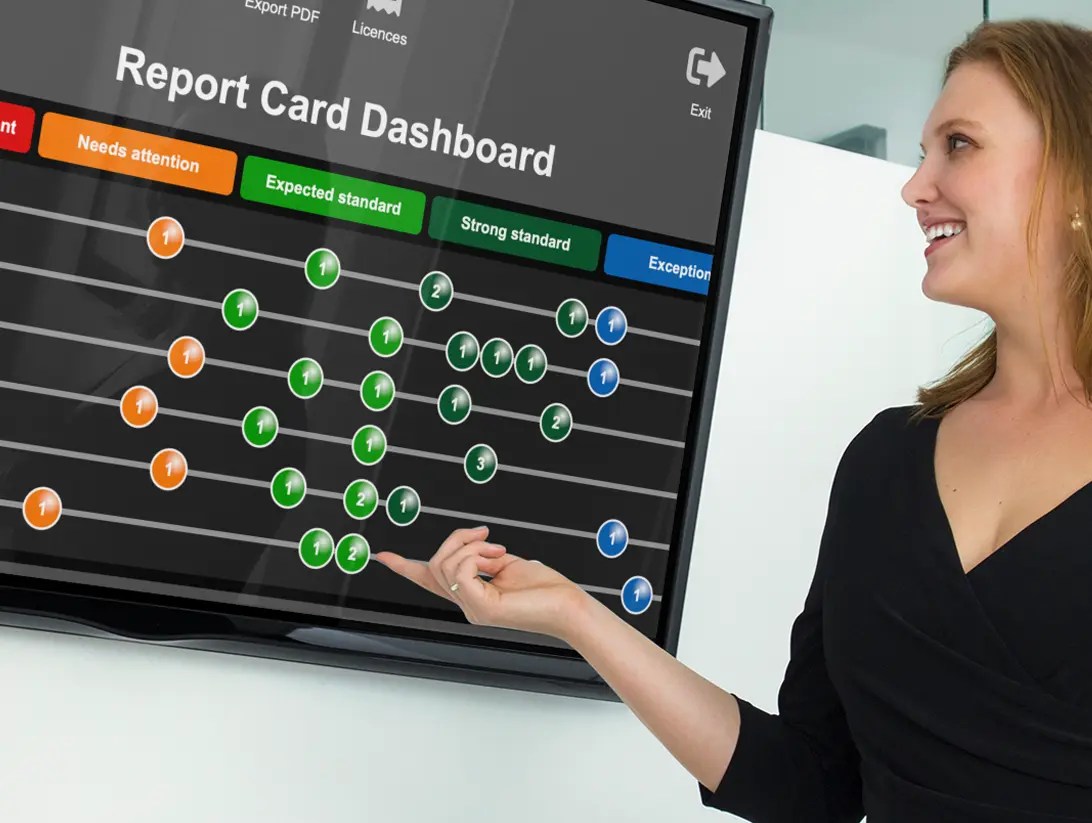
They are seeing the genuine, honest professional judgements of every headteacher in their trust — each one backed by evidence, each one informed by an analysis of what is helping and hindering that school's performance, each one connected to a specific improvement plan. They can click into any school, any evaluation area, and see the full human story behind it.
That is the difference between a data dashboard and an insight dashboard. Data tells you what. iAbacus tells you why — and what is being done about it.
Why this matters more than ever
With the new Ofsted inspection framework now live, every school in England is being evaluated across the same six areas on the same five-point scale. For the first time, trust leaders have a genuinely comparable framework across every school they lead.
The question is whether that framework is being used proactively — with schools evaluating honestly against the same criteria that inspectors will use, and trust leaders able to see that picture clearly — or whether it remains something schools only engage with when Ofsted arrives.
The trusts that use the new framework as a genuine improvement tool, not just an inspection framework, will be better prepared, better supported, and better placed to replicate excellence and direct support where it is needed most.
And none of that comes from AI. It comes from headteachers who know their schools, evaluating honestly, and from trust leaders who can see and act on what those evaluations reveal.
The iAbacus Report Card Dashboard
The iAbacus Report Card Dashboard is built specifically for MAT leaders who want to use the new Ofsted inspection toolkit as a tool for continuous improvement. Every school in the trust completes a genuine SEF and SIP aligned to the toolkit. As each school evaluates, the trust dashboard builds itself — a live, panoramic view of every academy, structured like the Ofsted report card.

The insight feeding that dashboard is genuine because it comes from headteachers evaluating for themselves — not filling in a form for someone else. That is what gives it integrity. And that is what makes the improvement planning that follows targeted, real, and lasting.
Human intelligence, structured and amplified. That is what school improvement has always run on.


