


It has been a turbulent few weeks for the Further Education and Skills sector. On one front, we have the fiscal reality check from the recent Budget, and on the other, the biggest shake-up to inspection in a decade.
The sector is facing a significant "squeeze" following the increase in employer National Insurance contributions, which is set to hit college and training provider budgets hard. Alongside this, the transformation of the Apprenticeship Levy into the 'Growth and Skills Levy' brings new uncertainties regarding funding flows for higher-level apprenticeships.
Simultaneously, the inspection landscape is changing fundamental shape. We are moving away from the dominance of the single-word headline judgement towards a clearer, more nuanced 'Report Card' system. This approach breaks down performance into specific areas, demanding a more detailed and transparent demonstration of quality rather than just a badge of honour. In this climate of tighter resources and higher scrutiny, efficient, robust self-evaluation is not a luxury—it is a survival mechanism.
Here is how iAbacus helps FE leaders navigate this dual challenge.
1. Aligning Instantly with the New Framework
The days of relying on a generic self-assessment are fading. The incoming Ofsted toolkit demands distinct judgements across specific areas, and if your current Self-Assessment Report (SAR) is a static document, it may already be out of step with the new requirements.
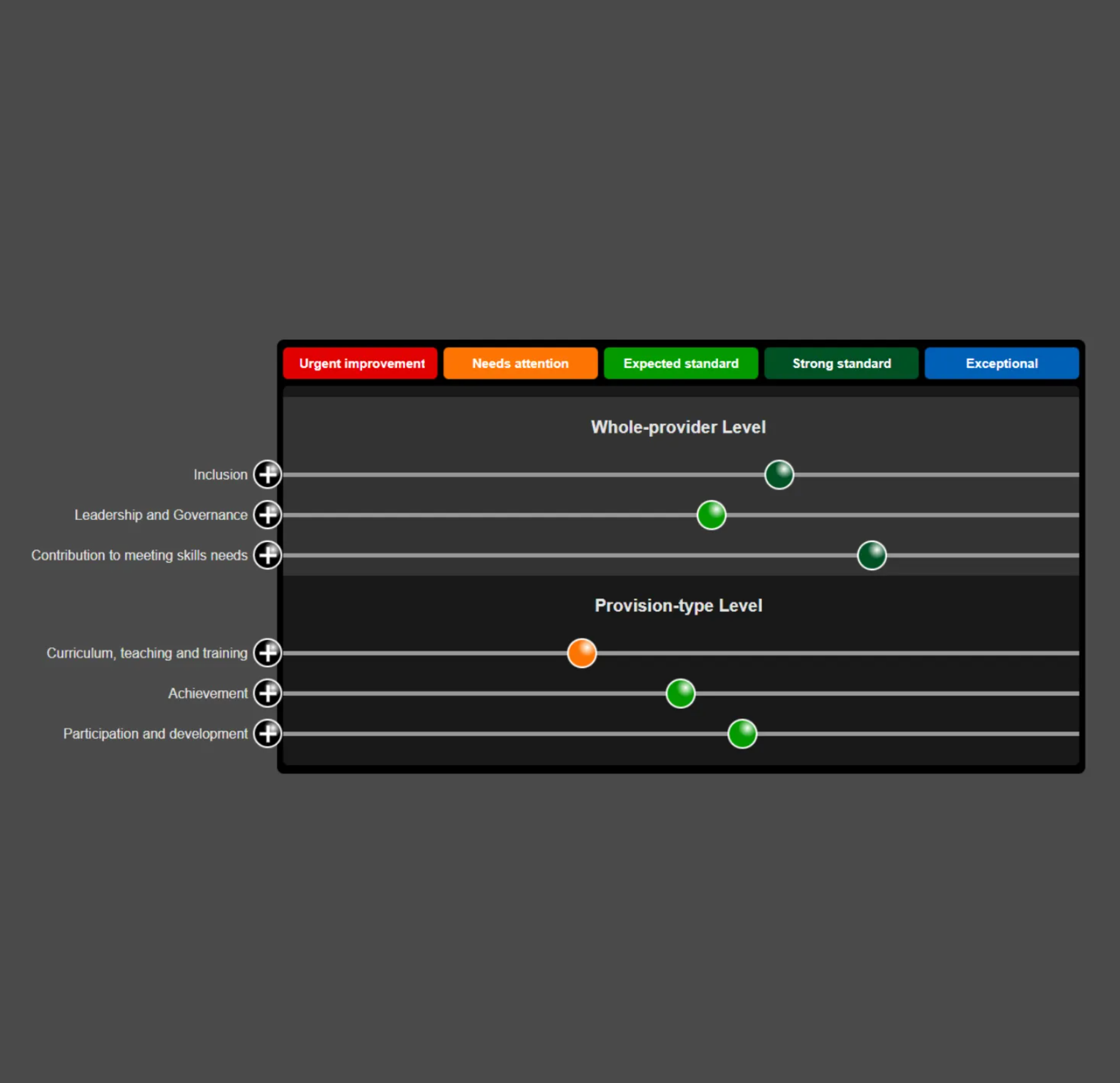
iAbacus has released a dedicated Ofsted Toolkit - Further Education and Skills template to help you prepare. This allows you to immediately restructure your self-evaluation around the new key headings:
- Inclusion
- Leadership and Governance
- Contribution to meeting skills needs
- Curriculum, teaching and training
- Achievement
- Participation and development .
By sliding the beads on the abacus for these specific areas, you can visually identify where your provision sits against the new performance levels: Urgent improvement, Needs attention, Expected standard, Strong standard, or Exceptional.
2. Evidence-Ready for the "Planning Call"
One of the most critical elements of the new inspection methodology is the enhanced importance of the planning call. This conversation sets the narrative for the entire inspection.
When an inspector asks how you are meeting local skills needs in your Engineering department compared to Health and Social Care, you cannot afford to be searching through shared drives for spreadsheets.
iAbacus links your evidence directly to your judgements. With a single click, you can access the data, employer feedback, or destination figures that justify your position. This turns the planning call from a stress test into a demonstration of robust, transparent leadership.
3. "Overlaying" Performance Across Diverse Faculties
FE colleges are complex organisms. A construction department operates very differently from a performing arts faculty. In a tight financial climate, leaders need to know exactly which departments are thriving and which are draining resources without results.
iAbacus allows Principals and Quality Nominees to use the Overlay feature. You can take the self-evaluations from every Head of Department and superimpose them onto one screen.
- Spot Trends: Is "Achievement" high across the board, but "Inclusion" dipping in vocational areas?
- Share Best Practice: Why is the Apprenticeship team scoring "Strong standard" on skills needs while A-Levels are only "Expected"?
This panoramic view allows for strategic resource allocation—vital when budgets are being squeezed.
4. Efficiency: Action Over Admin
With the financial pressures highlighted by the recent Budget, efficiency is paramount. Staff time spent formatting documents is money wasted.
iAbacus is designed to be a blessed relief from wading through pages of Word document plans. It forces brevity and focus. The "Force Field Analysis" tool helps teams quickly identify Helping Factors (strengths to build on) and Hindering Factors (barriers to remove). This moves the conversation rapidly from "what is happening" to "what are we doing about it", ensuring that your planning drives real, lasting change.
Conclusion: Continuous Improvement, Not Just Compliance
The shift to Report Cards signals that the inspectorate wants to see a culture of continuous improvement, not just a show put on for inspection week.
iAbacus is not just an "Ofsted tool"; it is a framework for sustainable quality assurance. Whether you are adapting to the new Growth and Skills Levy or refining your inclusion strategy, iAbacus ensures your planning is live, collaborative, and cost-effective.
Is your college ready for the new landscape? Explore the new FE & Skills template and see how iAbacus can streamline your quality cycle.


