


If you’re leading a nursery right now, you’re carrying a lot.
You’re thinking about children’s learning and well-being. You’re supporting a team who are often stretched. You’re reassuring parents, balancing finances, wrestling with staffing… and somewhere in the middle of all that, you’re expected to have a crystal-clear handle on Ofsted.
Then the phone rings before 10am.
Ofsted will be with you tomorrow.
In that moment, all the good work you and your team do every day can feel like it’s being squeezed into a single high-stakes event.
With the move away from a simple one-word judgement towards a richer “report card”, inspection is changing. In many ways, that’s a good thing – it reflects reality more fairly. Every setting has strengths. Every setting has areas to develop. Trying to sum you up in a single word never did you justice.
But there’s a catch.
The new approach expects you to tell a clear, coherent story about your nursery – your context, your strengths and your priorities for improvement. And it expects you to do that while you’re also dealing with ratios, rotas and real children in real rooms.
So the big question is this:
How do you turn the brilliant, messy, human reality of your nursery into a strategic story you can stand behind with confidence?
From firefighting to a clear narrative
Most days in nursery leadership are reactive by necessity.
A staff absence. A difficult conversation with a parent. A new child who needs something different. You are constantly “zoomed in” on the next hour or the next day.
Ofsted’s new world asks you to zoom out.
The planning call is a good example. Ofsted describe it as “a meaningful and professional conversation about the setting, its context, and leaders’ views about its strengths and priorities for improvement.”
That’s a fair expectation. But if your self-evaluation lives in a half-finished Word document or scattered notes, you don’t feel “meaningful and professional”. You feel like you’re trying to remember everything at once.
In my view, the key shift is this:
Self-evaluation has to move from being a one-off task to a living process you and your team own together.
A framework for your whole team’s voice
One of the most powerful things you can do as a leader is move away from “my self-evaluation” towards “our shared view”.
Room leaders and practitioners see things you don’t. They notice tiny changes in behaviour, curriculum and culture long before they show up in any report. The new Early Years toolkit actually encourages this, suggesting it can be used for self-evaluation and continuous improvement, not just inspection prep.
The challenge is practical:
How do you turn all those observations, instincts and insights into something coherent?
This is the problem I designed iAbacus to solve.
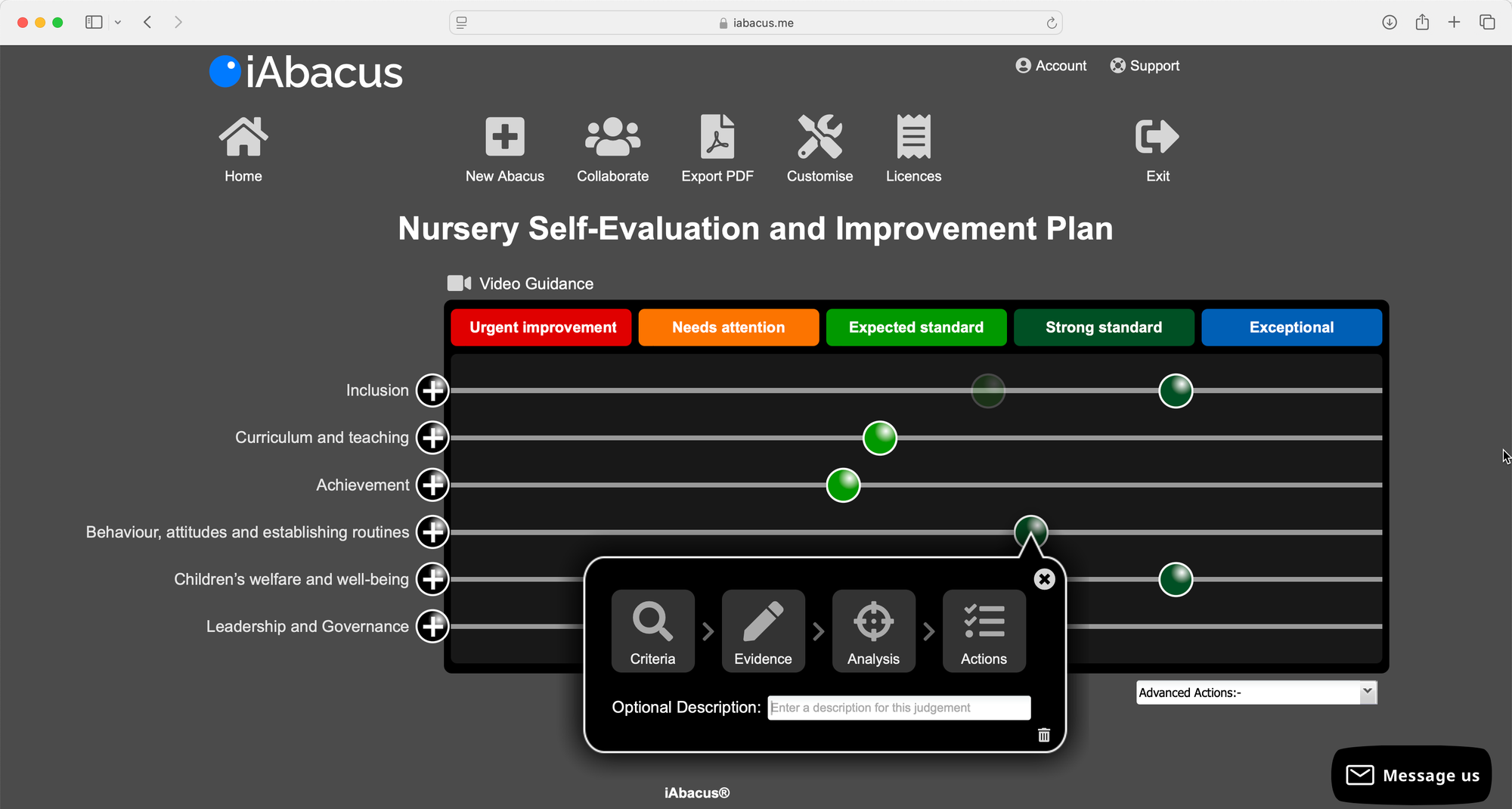
In simple terms, it gives you a shared visual space where you and your team can:
- Judge where you are now against the new Ofsted descriptors
- Add Evidence – from data to parent feedback to photos
- Analyse what’s really helping or hindering you
- Plan specific actions that strengthen the former and tackle the latter
It sounds formal, but in practice it feels like a structured professional conversation, captured in one place.
Imagine your next team meeting where, instead of talking in circles about “how we’re doing”, you’re looking together at a clear, visual summary of “Curriculum and teaching” or “Inclusion”, bead in position, evidence and analysis beneath it.
You’re no longer guessing. You’re describing.
More than inspection: telling the truth about your nursery
It’s easy to see self-evaluation as something you “do for Ofsted”.
In reality, done well, it’s something you do for yourself, your team and your children.
The new toolkit and inspection approach give you an opportunity:
- To celebrate the things your team do exceptionally well every day
- To be honest about challenges without feeling defensive
- To show that you understand your setting and have a realistic, thoughtful plan to keep improving
This is why I’m so passionate about turning self-evaluation from a solo paperwork chore into a calm, visual, collaborative process.
When you do that, something interesting happens:
- Your staff feel seen and involved, not “judged from above”
- Your improvement plan becomes a working tool, not a document that gathers dust
- And when Ofsted call, you’re not scrambling – you’re sharing a story you’ve already been living and refining as a team
Leading the Ofsted conversation, not just surviving it
Back to that planning call.
Picture it again, but differently.
Instead of frantically reminding yourself what’s in which file, you have your evaluation open in front of you. For each area, you can see:
- The judgement you’ve made
- The key evidence that supports it
- The helping and hindering factors you’ve identified
- The actions you’ve taken – and the impact you’re seeing
You’re not trying to impress the inspector. You’re simply walking them through the journey you and your team are already on.
That’s what Ofsted are really looking for: leaders who know their setting, can articulate its strengths and challenges, and are actively working to improve.
A calmer way forward
If you’re feeling the weight of Ofsted’s “new world”, you’re not alone. Every nursery leader I speak to describes some version of the same tension: “I know we’re doing good work – I just need a clear way to show it, to my team, to inspectors and to myself.”
My belief is simple:
You deserve a way of working that matches your professionalism – calm, clear and collaborative, not frantic and fragmented.
That’s why I built iAbacus and why I’ve adapted it specifically for the new Early Years toolkit.
If you’d like to see exactly how the process works in practice, I’ve recorded a short 10-minute video walkthrough of the new toolkit inside iAbacus. No jargon, no fluff – just the process, step by step.
You can watch it here:
And if you’d prefer a conversation, I’m always happy to have a brief one-to-one chat about your nursery and how you’re approaching the new framework.
Either way, thank you for the work you do. It matters more than any framework.
Book a slot on my calendar and we'll jump on Zoom or Teams.


