


If you’re leading a school or a trust right now, you probably have three recurring questions about your subjects:
- How strong is each subject department, really?
- Are we applying the same standard everywhere?
- Are our subject leaders actually being helped to improve – or just asked to “be Ofsted-ready”?
Most systems don’t answer those questions well.
You get separate SEFs, spreadsheets, deep-dive notes and emails. Some subject departments write beautifully detailed self-evaluations; others produce three bullet points and a grade. It’s hard to see the whole picture, never mind act on it.
When Ofsted published the schools inspection toolkit, we saw an opportunity to do something more helpful for subject self-evaluation and subject leadership.
The problem: whole-school tools, subject-level reality
The toolkit is a useful development. It sets out, in clear language, what “urgent improvement”, “expected”, “strong” and “exceptional” look like across key areas such as:
- Inclusion
- Curriculum and teaching
- Behaviour and attitudes
- Personal development
- Leadership
The catch is that it’s written for whole-school leadership, not for the people heading up English, Maths, Science, PE or Art.
So subject leaders are often left to:
- Interpret whole-school descriptors like “leaders ensure…” and “the school’s approach to attendance…”
- Work out what that means for their subject department
- Then design their own subject self-evaluation proformas on top
That creates three familiar issues for headteachers and trust leaders:
- Inconsistency – every subject department describes itself differently
- Workload – subject leaders repeatedly reinvent criteria that already exist nationally
- Misalignment – your internal language doesn’t quite match the language inspectors will use
We wanted to remove those issues, not add to them.
What we’ve done: the Ofsted toolkit, rebuilt for subject leaders
We took the schools inspection toolkit and reworked it, line by line, so it genuinely sits at subject department level. (If you'd like this PDF - email me dan@opeus.org.)
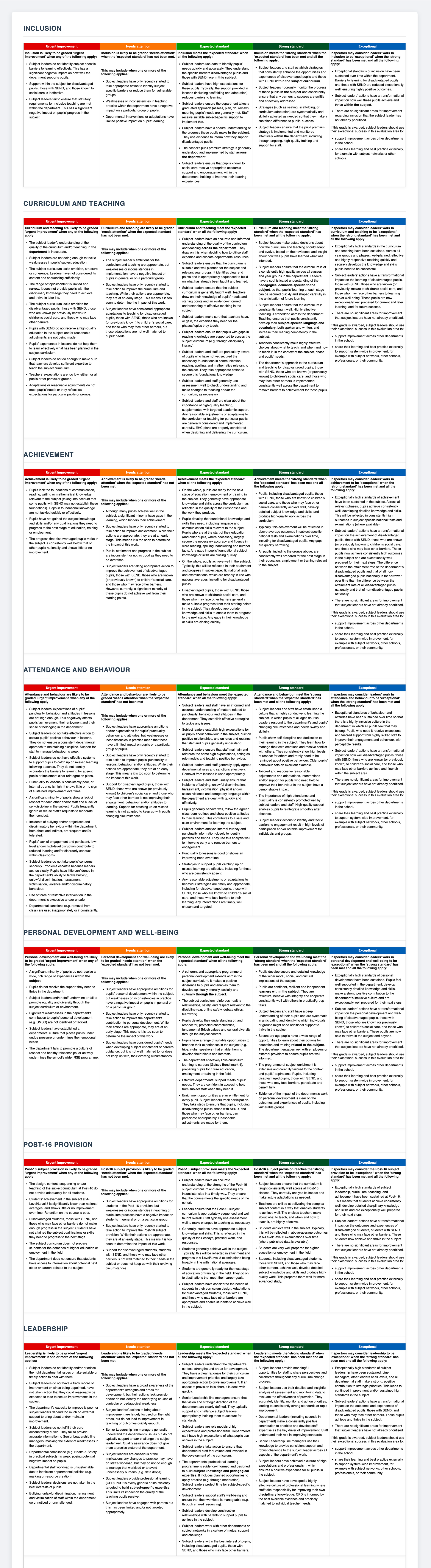
In practice, that means:
- “Leaders” becomes “subject leaders” or “department leaders”
- “School” becomes “department” or “subject area”
- Whole-school attendance systems become punctuality to lessons, internal truancy and engagement in this subject
- “Range of subjects” becomes “range of content/topics” and disciplinary knowledge in the subject
- SEND is reframed from diagnosis to “identifying barriers to learning this subject” and using existing SEND information to adapt teaching
We also removed things that a Head of Department cannot sensibly control, such as:
- Exclusions and suspensions
- Admissions and alternative provision
- Statutory attendance coding and legal interventions
- The Single Central Record and estates
What’s left is a subject self-evaluation framework that:
- Uses Ofsted’s evaluation areas and standards
- Speaks directly to subject leaders
- Stays within their actual sphere of influence
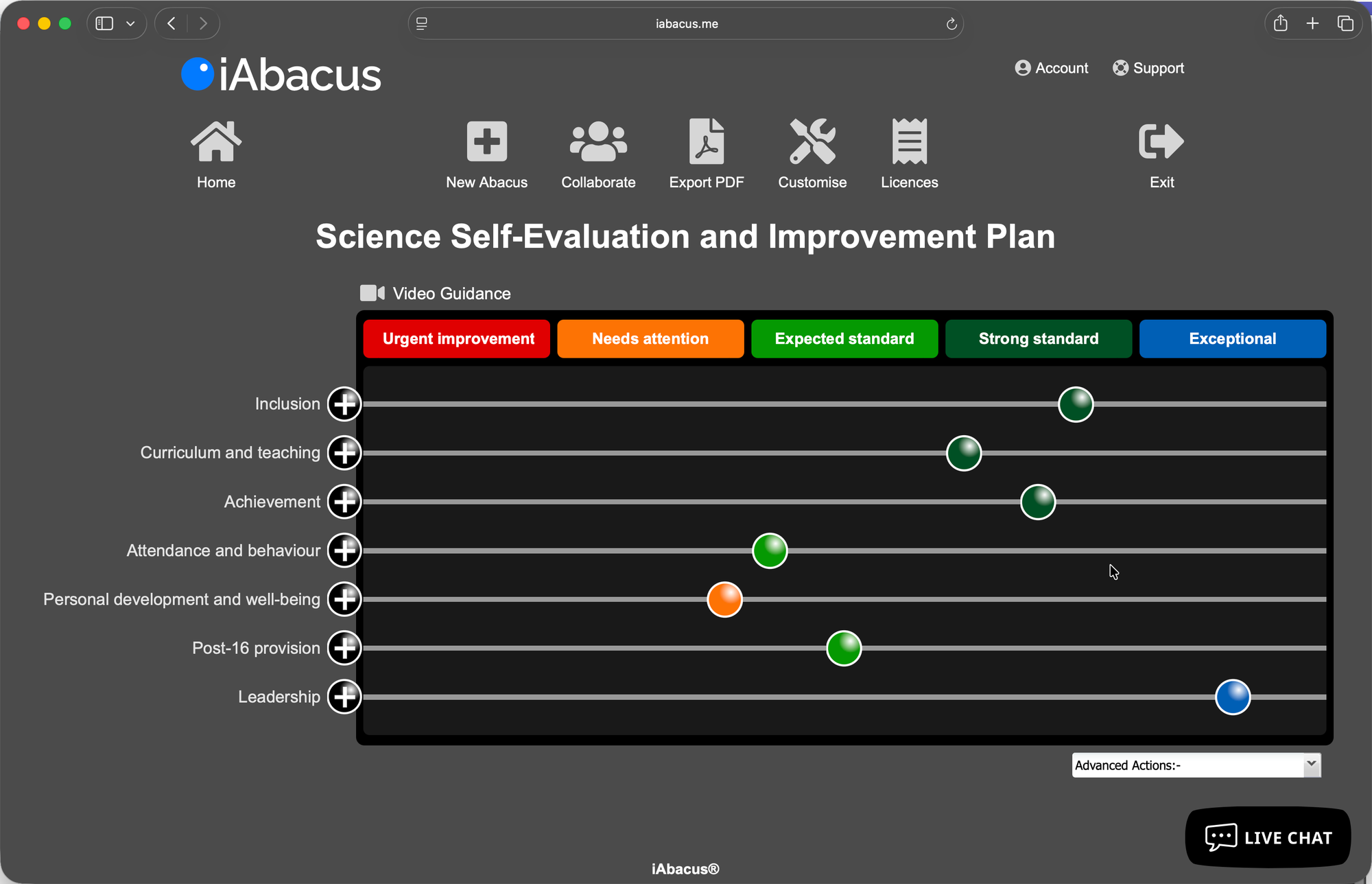
We then built it straight into iAbacus as a subject-leader template, ready for each subject department to use.
What this gives you as a school or trust leader
Rather than list features, it’s more useful to look at the practical benefits for you and your subject leaders.
1. One clear standard for every subject department
Every subject department is now working with:
- The same areas: Inclusion, Curriculum and teaching, Achievement, Attendance and behaviour, Personal development and well-being, Post-16 (if relevant), Leadership.
- The same five levels: urgent improvement, needs attention, expected, strong, exceptional.
- Subject-appropriate wording that mirrors the Ofsted toolkit.
That means when you read evaluations from English, Science and PE, you are comparing like with like. “Strong” for subject inclusion in English means the same level of robustness as “strong” for subject inclusion in Maths, even though the examples differ.
On the abacus, this appears as consistent columns and colours across subjects.
2. Honest, grounded subject self-evaluation
Because the descriptors are written for subject leaders, they can answer questions like:
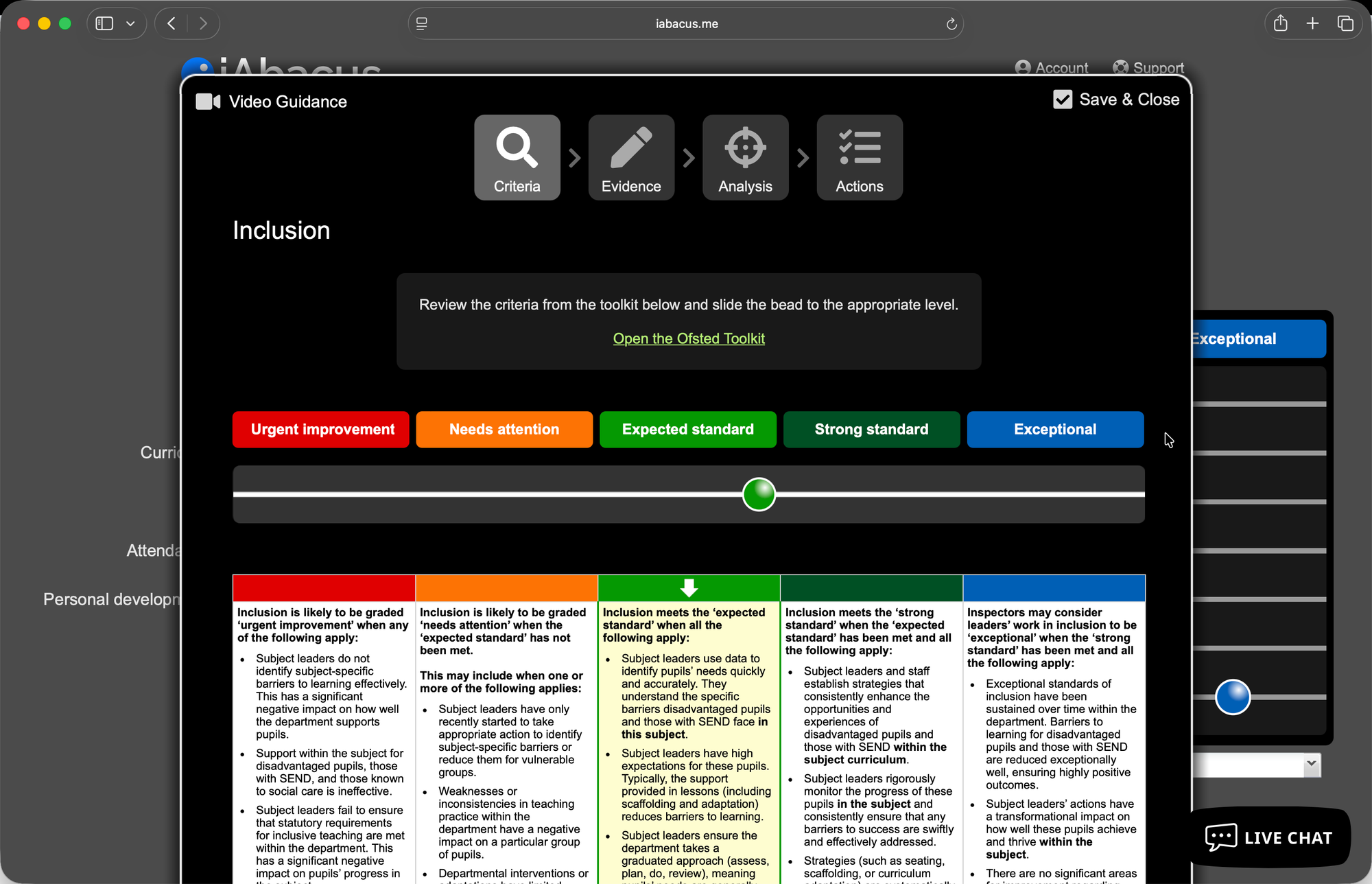
- “Are we genuinely at ‘expected’ for inclusion in this subject?”
- “What would ‘strong’ look like for curriculum and teaching in our subject department?”
No one has to translate whole-school language or invent their own criteria.
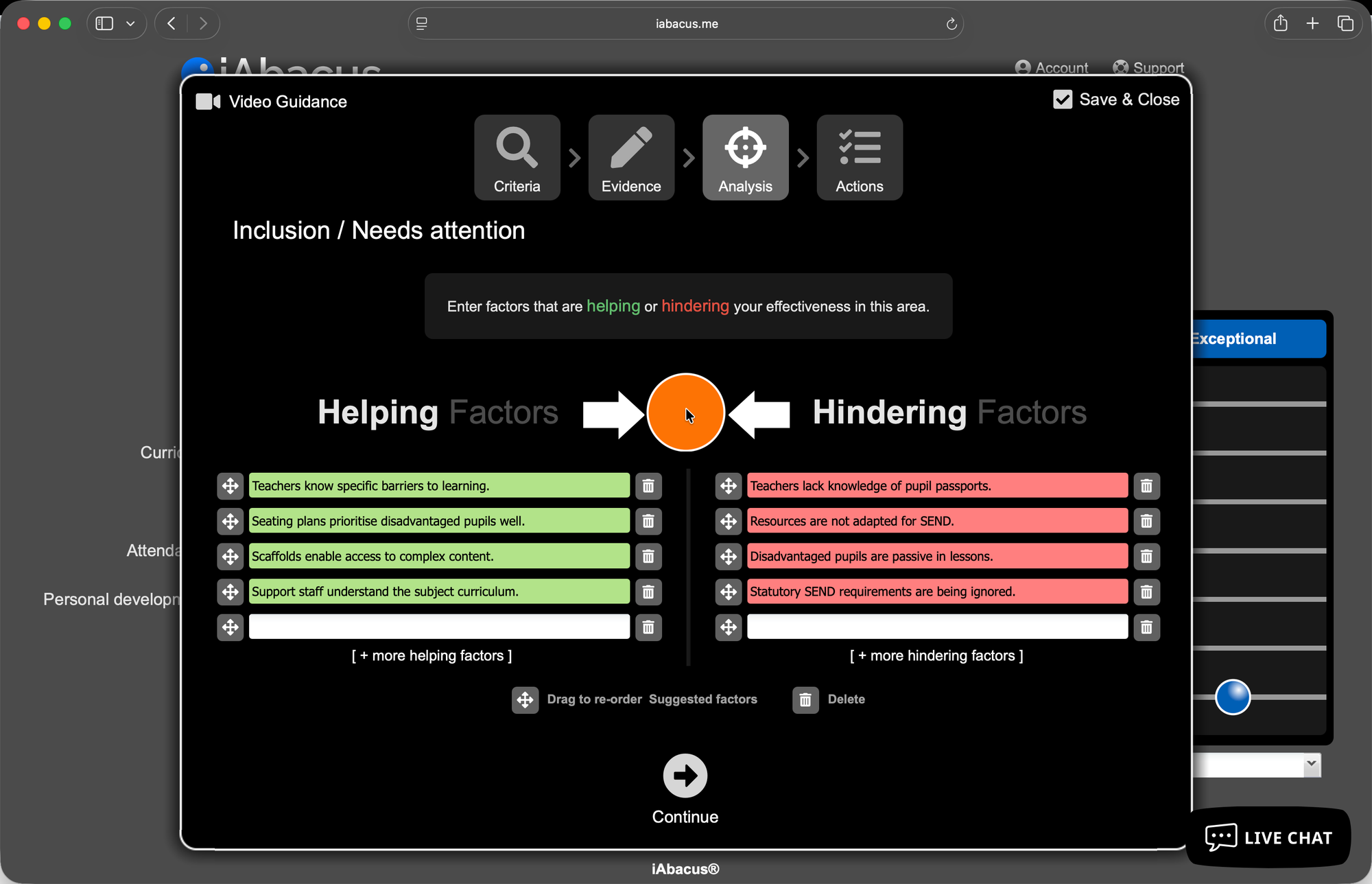
In iAbacus, each subject leader:
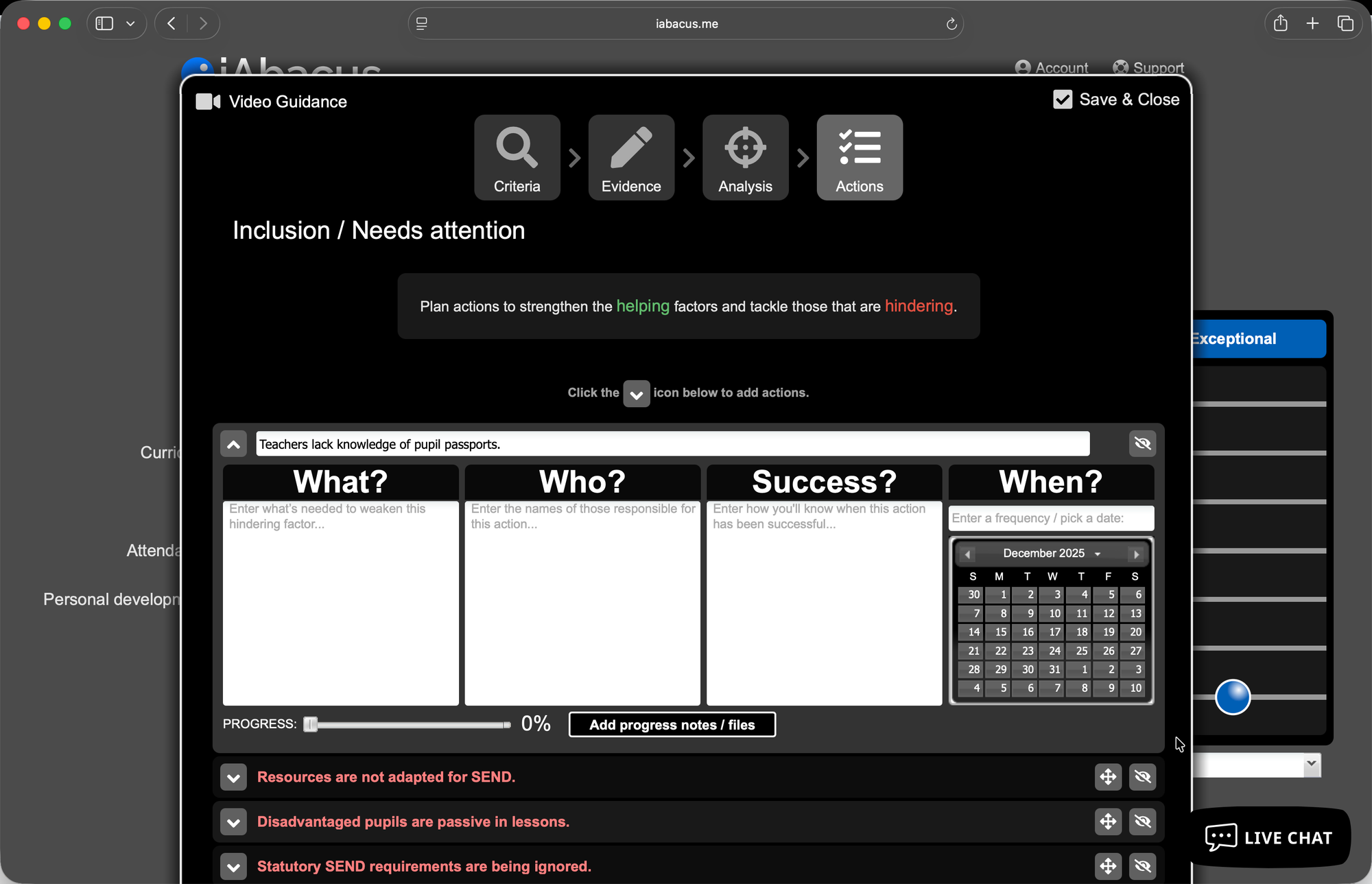
- Places a bead at the level that best matches their current reality
- Notes what is helping them sit there
- Notes what is hindering them from moving to the next level
- Agrees a small number of focused actions
For you, the benefit is clear: you get subject self-evaluations that are specific, honest and comparable, rather than vague grades with generic commentary.
3. A visual, strategic view of all subjects
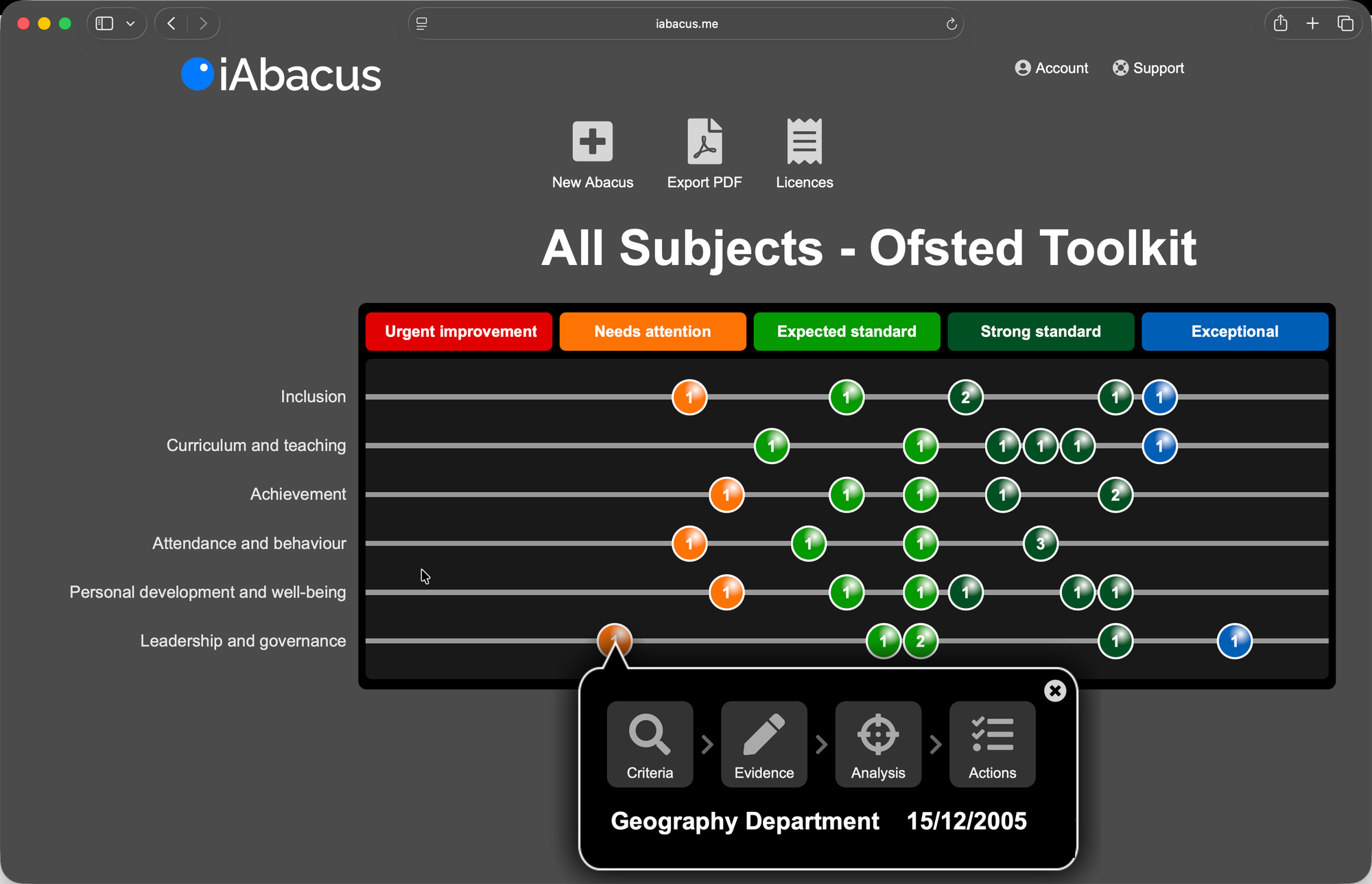
From a leadership perspective, the value grows when you overlay all subject departments in one view.
The overlay allows you to:
- Scan across subjects and spot patterns
- e.g. “Curriculum and teaching look strong in most subject departments, but inclusion is weaker in several.”
- Identify internal expertise
- e.g. “Modern Languages is exceptional on behaviour in subject lessons – can they support other teams?”
- Focus support where it’s needed most
- e.g. “Two subject departments are at ‘urgent improvement’ for achievement; we need to understand the causes and plan support.”
Instead of juggling separate SEFs, spreadsheets and deep-dive notes, you have a clear, visual summary of subject strength and need.
4. Better conversations with subject leaders
Because the framework is shared and explicit, it changes the quality of line management conversations with subject leaders.
Meetings move from:
“What grade would you give your subject department?”
to:
“You’ve placed the bead at ‘needs attention’ for achievement in your subject. The criteria mention gaps in learning and inconsistent outcomes. What’s driving that, and what support will make the biggest difference?”
That is a more professional, more humane conversation – and far more likely to lead to improvement in subject teaching and subject outcomes.
And because everything sits within the same abacus, you can revisit later, move the bead if practice has improved, and see the journey for each subject department over time.
5. Less duplication, more clarity
Finally, this approach reduces the amount of separate paperwork your system generates around subjects.
You don’t need:
- A different home-grown subject SEF for each department
- A separate Ofsted prep document using different language
- Another improvement planning template on top
Instead, you have:
- One Ofsted-aligned, subject-specific framework
- One visual tool to evaluate, plan and review
- One coherent way of talking about subject quality across your school or trust
The gain is not just efficiency; it’s clarity.
Everyone understands the standard.
Every subject department can see where it currently sits.
Every subject leader can show what they are doing about it.
If you’re reviewing subject leadership and subject quality…
If you are currently:
- Strengthening your subject review process
- Preparing for inspection and want a fairer way to involve subject leaders
- Building a trust-wide view of subject departments and curriculum quality
…this subject-leader framework inside iAbacus may be a useful piece of the puzzle.
I’m always happy to walk through it with school and trust leaders, show how it looks with real subject departments, and let you decide whether it fits your context and culture.
No drama, no hard sell – just a clearer, fairer way to answer those three questions:
- How strong is each subject department?
- Are we applying the same standard everywhere?
- And are our subject leaders genuinely being helped to improve?
Book a slot on my calendar and let's talk about your school.


